Winter Arc 2026: what it means, when it starts and how to do it
In short
The Winter Arc is an internet self-improvement challenge where you use the last months of the year to train, sleep and work with more discipline before January. Nobody owns it, so there are no official dates or rules. Most people run it from October 1 or early November to December 31, and it's never too late to start a shorter version.
Key takeaways
- The Winter Arc is a social media trend, not an official program, so you set your own start date, end date and rules.
- The most common window is October 1 to December 31, which is 92 days in 2026; a November start or a 21-day finish works just as well.
- Five rules carry most of the weight: a fixed sleep window, training that fits your level, eating on purpose, one focus block a day and a daily check-in.
- Bulking or cutting is a personal choice; for beginners, showing up three or four times a week matters more than either.
- If you start late, run a 21-day arc: it ends on December 31 if you start on December 11.
On this page11 sections
What is the Winter Arc?
The Winter Arc is a self-improvement challenge where you treat the last months of the year as a focused training block. You tighten up sleep, training, food and work so you walk into January already moving, instead of waiting for a New Year's resolution. The "arc" comes from the idea of a character arc in a story: the stretch where the hero gets quietly, steadily better.
In practice, a Winter Arc is a short list of daily rules you keep from a start date to an end date. Early gym sessions, a fixed bedtime, less scrolling and real study or work blocks are the usual ingredients.
Is the Winter Arc a real thing?
Yes, as a trend. No, as an official program. Know Your Meme traces the phrase to a September 2022 Urban Dictionary entry and posts on X in October 2022. It spread through gym TikTok in 2023 and blew up in autumn 2024, when head-shaving "Day 1" videos went viral.
The best reply from that wave was a comment that the Winter Arc is "not a double XP event," as Know Your Meme's write-up notes. That's the honest version. Winter doesn't make you faster. It just gives you a clear start, a clear finish and a reason to start now.
What is a winter challenge?
A winter challenge is any fixed-length challenge you run in the cold months, usually with daily rules and a tracker. The Winter Arc is the best-known one. Because nobody owns it, you can make it as hard or as simple as your life allows. That's also the risk: with no structure, most people write 12 rules on October 1 and quit by October 9.
Which date does the Winter Arc start and end?
There's no official start or end date. The most common window is October 1 to December 31, and plenty of people start on the first Monday of November instead. Fitness-first versions run longer: bulk through winter, then cut before summer. Gymshark describes October 1 to January 1 as the usual run.
| Window | 2026 dates | Length | Best for |
|---|---|---|---|
| Classic | Thu Oct 1 – Thu Dec 31 | 92 days | People who planned ahead |
| November start | Mon Nov 2 – Thu Dec 31 | 60 days | Most people who heard about it late |
| Mid-November sprint | Mon Nov 16 – Sun Dec 6 | 21 days | Finishing a block before the holidays |
| Year-end finish | Fri Dec 11 – Thu Dec 31 | 21 days | Late starters who want to end the year on a streak |
| Gym version | Oct 1 – early summer | 6–8 months | A planned bulk then cut |
Is it too late to start the Winter Arc?
No. There's no deadline because there's no organiser. On November 14, 2026 there are still 48 days left in the year, counting today.
Starting on a fresh date can help. In a study of Google searches, gym visits and goal sign-ups, Dai, Milkman and Riis (2014) found all three rose after "temporal landmarks" like a new week, month or year. They called it the fresh start effect. So if you missed October 1, pick the next Monday and call it Day 1.
Winter Arc rules for men: the five that matter
There are no official Winter Arc rules, so here are the five that do most of the work. Keep each one small enough to hit on a bad day. You can raise the bar in week three.
- Fixed sleep window. Same wake time every day, weekends included, within 30 minutes. The CDC recommends 8–10 hours a night for teens aged 13–17 and 7 or more for adults.
- Train at your level. The adult guidelines are 150 minutes of moderate activity a week plus two days of strength work. For ages 6–17, it's 60 minutes a day with strength work on three days.
- Eat on purpose. Protein at two or more meals, one home-cooked meal a day, and fewer late-night snacks. No crash diets.
- One focus block a day. 25 to 90 minutes of study, work or a skill with the phone in another room.
- Daily check-in. Tick your list and write one line about the day. Thirty seconds, every night.
What isn't a rule: shaving your head, 4 a.m. alarms, ice baths or cutting off friends. Do them if you want. They're style, not substance.

See the numbers
| Number | What it means | Note |
|---|---|---|
| 8–10 h | sleep a night, teens 13–17 | |
| 7+ h | sleep a night, adults 18–60 | |
| 150 | minutes a week of moderate activity, adults | plus strength work on 2 days |
| 60 | minutes a day of activity, ages 6–17 | plus strength work on 3 days a week |
How to enter the Winter Arc in 7 steps
To enter the Winter Arc, you set an end date, write a few daily rules and start on a clear Day 1. Here's the full setup, which takes about 20 minutes.
- Pick your end date. December 31 is the obvious one. Count back to see your length.
- Pick your Day 1. A Monday or the first of a month gives you a clean fresh start.
- Write three to five rules. One per area you care about: sleep, training, food, focus, screens.
- Turn each rule into an if-then plan. "If it's 6:30 pm on a weekday, I put on my gym clothes." A meta-analysis of 94 tests by Gollwitzer and Sheeran found this kind of plan had a medium-to-large effect on reaching goals.
- Write your minimum version. For each rule, the smallest version that still counts, such as 10 push-ups instead of a full session.
- Decide your miss rule now. Never miss twice in a row. In Lally and colleagues' 2010 habit study, missing one chance to do a behaviour did not materially affect habit formation.
- Print the checklist. Use the one at the bottom of this page, or build a full plan with the Winter Arc planner.
Is Winter Arc bulking or cutting?
It can be either, and it doesn't have to be either. Gym culture leans toward a winter bulk and a spring cut. Gymshark notes that bulking is the more common choice in winter.
If you're new to lifting, skip the question for now. Train three or four times a week, eat protein at most meals and sleep. That alone will change how you look and feel by New Year's.
If you do bulk, keep it modest. A 2019 review in Frontiers in Nutrition points out that eating more alone isn't a body-composition plan. In one 100-day overfeeding study, lean young men gained about 2 kg of fat for every 1 kg of lean mass. The authors suggest a conservative surplus and watching strength and body changes. If you're under 18 and still growing, don't diet hard. Eat enough and train well.
Three example Winter Arc routines
The right Winter Arc depends on your week. Here are three routines built on the same five rules, each sized for a different life.
The student (school, exams, 16–22)
| When | Rule |
|---|---|
| 7:00 | Up, water, bed made |
| Before school | 10-minute walk or 20 push-ups and squats |
| After school | One 50-minute study block, phone in another room |
| 3–4 evenings a week | Gym, sport or a 30-minute home workout |
| 22:30 | Phone charging outside the bedroom, lights out by 23:00 |
During exam weeks, cut training to a minimum version (20 minutes) and keep the sleep rule. Sleep is the rule that protects your grades.
The 9-to-5 guy
| When | Rule |
|---|---|
| 6:30 | Up at the same time every day, including weekends |
| Commute or lunch | 20-minute walk or a podcast for your skill |
| 18:30 Mon/Wed/Fri | Gym, 45–60 minutes |
| After dinner | 45-minute focus block on a side project, course or reading |
| 22:30 | Screens off, lights out by 23:00 |
The 9-to-5 trap is the evening. Decide on Sunday which three evenings are training nights so the decision is already made.
The gym beginner
| Week | Training | Food |
|---|---|---|
| 1 | 3 full-body sessions, 30 minutes, learn the movements | Protein at breakfast |
| 2 | 3 sessions, add one set per exercise | Protein at two meals |
| 3 | 3–4 sessions, add a little weight where form is clean | One home-cooked dinner a day |
| 4+ | Keep adding small amounts of weight or reps | Keep it boring and steady |
Start lighter than you think. The goal of the first month is to show up and learn the movements, not to get hurt in week two.
The Sunday review: how to keep a Winter Arc going past week two
Most Winter Arcs die in week two, not week one. The fix is a 10-minute review every Sunday night, before the new week starts.
Ask four questions and write the answers down:
- Score: How many checklist ticks did I get out of 42 (six a day for seven days)?
- Best rule: Which rule did I hit every day? Keep it exactly as it is.
- Weak rule: Which rule did I miss most? Make it smaller, or move it to a different time of day.
- Next week: Which three training days, and what's the one thing my focus blocks are for?
Then change one thing, never three. If you hit 35 or more out of 42, add a little: one more set, 15 more minutes of focus. If you hit under 25, shrink the rules until a bad day still counts. A Winter Arc that bends a little each week lasts. One that never changes usually snaps.
For more on keeping going after the first burst, see how to stay consistent.
The 21-day Winter Arc (late-start version)
If you're reading this in late November or December, run a 21-day arc. It's short enough to finish and still ends the year strong. Start on December 11 and Day 21 lands on December 31.
- Days 1–7, start: Wake time, a 20-minute workout and the nightly check-in. Nothing else.
- Days 8–14, rhythm: Add the focus block and protein at two meals. Train four days.
- Days 15–21, proof: Keep everything. Add one stretch goal, such as a longer run or a 90-minute study block. Look back at your checklist on Day 21.

Text version
| Step | What | Detail |
|---|---|---|
| Dec 11–17 | Start | Wake time, a 20-minute workout and the nightly check-in. Nothing else. |
| Dec 18–24 | Rhythm | Add the focus block and protein at two meals. Train four days. |
| Dec 25–31 | Proof | Keep everything and add one stretch goal. Look back on Day 21. |
21 days is a plan length, not a promise that habits are done by then. In Lally's study, the median time to automaticity was 66 days. More on that in how long it takes to form a habit. For a ready-made version, try the 21-day plan generator.
Winter Arc daily checklist
Print this or copy it into your notes app. It's the checklist block on this page, too.
Score yourself out of six each night. A five is a good day. Don't chase sixes every day in week one.
A note on winter itself: dark mornings and cold can make everything harder. If your mood drops hard every winter, that's worth taking seriously. The National Institute of Mental Health describes a winter pattern of seasonal depression. This isn't medical advice: if sleep or mood problems persist, talk to a doctor.
How to finish the Winter Arc (and what comes after December 31)
Finish on purpose. On your last day, count your checklist ticks, note your best streak and write down which rule changed the most.
Then keep two rules and drop the rest for a week. The arc was a sprint. January is where you find out which rules you actually own. If you want a second block, our New Year reset picks up right where this ends. If you'd rather cut screens than add training, see monk mode.
Doing the Winter Arc with a 21-day plan
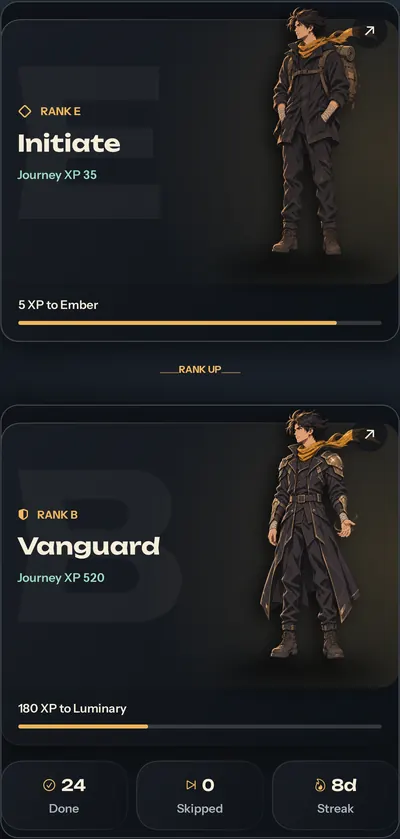
If you like structure, a ready-made plan saves the setup. Zenith: Level Up in 21 Days, an anime-inspired habit app for iPhone, turns your next three weeks into daily real-life challenges. Your plan is a mountain, Day 1 at the base and Day 21 at the summit, and your character moves up from E Initiate toward S Ascendant as you earn XP. A Wake cue covers the morning reminder. You still do the work and tick it off yourself. It's available to pre-order on the App Store, and Apple expects Nov 20, 2026. See how the weeks work on the 21-day plan page.
Plan it with the Winter Arc Planner
Winter Arc PlannerDaily non-negotiables on a printable calendar.Free toolQuestions people ask
Is the Winter Arc a real thing?
Yes, as a trend, but not as an official program. The phrase shows up online from 2022 and took off on TikTok in autumn 2024. No company or governing body owns it, so there are no official rules or dates. That's the useful part: you write your own rules, pick your own window and judge yourself on whether you showed up.
Which date does the Winter Arc start and end?
There's no official date. The most common window starts on October 1 and ends on December 31 or New Year's Day. Plenty of people start in early November instead, and fitness-focused versions run until summer, with a winter bulk and a spring cut. In 2026, October 1 to December 31 is 92 days; November 1 to December 31 is 61.
Is it too late to start the Winter Arc?
No. Because nobody owns the Winter Arc, there's no cutoff. From mid-November 2026 you still have about seven weeks before December 31. If you start in December, run a 21-day arc instead of a 92-day one. Starting on December 11 ends exactly on December 31, so you finish the year on a streak.
Is Winter Arc bulking or cutting?
Either, and you don't have to do either. Gym culture leans toward a winter bulk and a cut before summer. If you're new to lifting, focus on training three or four times a week, eating enough protein and sleeping well. If you do bulk, keep the surplus modest: in one overfeeding study, lean young men gained about 2 kg of fat for every 1 kg of lean mass.
How do you enter the Winter Arc?
Pick an end date, write three to five daily rules you can keep on your worst day, and turn each into an if-then plan, such as 'If it's 6:30 pm, I go to the gym.' Put the rules on a checklist, start on the next Monday or the first of a month, and tick the list every night. Plan now for what you'll do after a missed day.
What should be done in the Winter Arc?
The usual focus areas are training, sleep, food, study or work, and less scrolling. Pick one rule from each area you care about rather than ten rules at once. A good Winter Arc for a student, a 9-to-5 worker and a gym beginner looks different, but each has a fixed bedtime, regular training and one focused block of work every day.
Sources
- Winter ArcKnow Your Meme, 2024
- What Is the Winter Arc and Why Are People Acting Like It's a Double XP Event?Know Your Meme, 2024
- What Is The Winter Arc? The Viral TikTok Challenge ExplainedGymshark, 2024
- The Fresh Start Effect: Temporal Landmarks Motivate Aspirational BehaviorManagement Science (Dai, Milkman and Riis), 2014
- Implementation intentions and goal achievement: A meta-analysis of effects and processesAdvances in Experimental Social Psychology (Gollwitzer and Sheeran), 2006
- How are habits formed: Modelling habit formation in the real worldEuropean Journal of Social Psychology, 2010
- Physical Activity Guidelines for AdultsU.S. Centers for Disease Control and Prevention, 2024
- Physical Activity Guidelines for Children and AdolescentsU.S. Centers for Disease Control and Prevention, 2024
- About SleepU.S. Centers for Disease Control and Prevention, 2024
- Is an Energy Surplus Required to Maximize Skeletal Muscle Hypertrophy Associated With Resistance TrainingFrontiers in Nutrition (Slater et al.), 2019
- Seasonal Affective DisorderNational Institute of Mental Health, 2024