New Year reset 2027: a checklist and a 21-day January plan
In short
A New Year reset is a short, planned restart: one reset day to clear your room, phone, money and calendar, then a fixed plan for the first weeks of January. For 2027, do the reset day between December 27 and January 3, then run 21 days from Monday, January 4 to Sunday, January 24. Use goals you move toward, not things you avoid.
Key takeaways
- Do one reset day before January 4, 2027: room, phone, money, body, calendar and people.
- Run a 21-day plan from Monday, January 4 to Sunday, January 24, with one new rule added each week.
- In a study of 1,066 people, 58.9% with approach goals said they kept their resolution after a year, against 47.1% with avoidance goals.
- New starts like a new year, month or week give a real motivation bump, so use it to set up systems, not just intentions.
- Plan for a missed day in advance: never miss twice in a row.
On this page9 sections
What is a New Year reset?
A New Year reset is a short, planned restart for the new year: one reset day to clear your space and set up your week, followed by a fixed plan for the first few weeks of January. It's the opposite of a vague resolution. Instead of "get in shape," you leave the reset day with a wake time, three training days in your calendar and a checklist.
For 2027 the dates are simple. January 1 is a Friday. Do your reset day any time from December 27 to January 3, then start your plan on Monday, January 4.
Is 2027 a year of reset?
Any year can be, if you plan it. There's nothing magic about the number, but there is something real about the date. Dai, Milkman and Riis (2014) found that Google searches for "diet," gym visits and goal sign-ups all rose after new starts like a new year, month or week. They called it the fresh start effect.
The catch: the bump fades. Use January's motivation to build a system, so you aren't relying on motivation in February.
Why New Year's resolutions fail, and what works instead
Resolutions usually fail because they're vague, too big or framed as stopping something. The research points to a few clear fixes.
The best recent data comes from a 2020 study in PLOS ONE that followed 1,066 people for a year. Overall, 55% said they'd kept their resolution. People with approach goals, things to start doing, did better: 58.9% against 47.1% for avoidance goals, things to stop doing. The group that got a little support did best, too.

See the numbers
| Value (%) | |
|---|---|
| Approach (start doing) | 58.9% |
| All responders | 55% |
| Avoidance (stop doing) | 47.1% |
Three fixes follow from that:
- Phrase it as something you do. "Train Monday, Wednesday and Friday at 18:30" beats "stop being lazy."
- Attach it to a time and place. If-then plans had a medium-to-large effect on reaching goals across 94 tests.
- Plan for a miss. In Lally and colleagues' habit study, missing one day didn't materially affect habit formation. Missing a week is a different story. The rule: never miss twice in a row.
Turn your resolution into a rule
Here's how to rewrite the usual resolutions into approach goals you can tick off. This is the step most people skip.
| Resolution | Avoidance version | Rule you can tick |
|---|---|---|
| Get fit | Stop skipping the gym | Gym Mon/Wed/Fri at 18:30, 45 minutes |
| Eat better | No junk food | Protein and a vegetable at lunch and dinner |
| Less phone | Stop scrolling | Phone charges in the kitchen from 22:30 |
| Sleep better | Stop staying up late | Lights out 23:00, up 7:00, every day |
| Save money | Stop wasting money | Move a set amount to savings on payday |
| Study more | Stop procrastinating | One 50-minute study block before dinner |
| Be happier | Stop being negative | 20-minute walk outside and one line in a journal daily |
New Year reset checklist for men
Do this in one afternoon between December 27 and January 3. It takes three to four hours.
What are some ideas for a reset day?
Beyond the checklist: wash your gym kit and lay it out, clean your shoes, batch-cook lunches for the first week, clear your inbox, set up a simple tracker, and walk somewhere for an hour with no headphones to think about the year. Pick what fits. The point is to start Monday with nothing to sort out.
Is it reset Sunday or Sunday reset?
Both are used, and they mean the same thing. "Sunday reset" is the more common phrase for a weekly routine of tidying, planning and prepping for the week. Think of the New Year reset as the big annual version, and the Sunday reset as how you keep it going. Every Sunday in January, spend 20 minutes on a mini version: room, food, calendar, three rules for the week.
The 21-day January plan (January 4–24, 2027)
Three weeks, one new rule a week. You start small on purpose.
| Week | Dates | Theme | Add this rule | Keep |
|---|---|---|---|---|
| 1 | Mon Jan 4 – Sun Jan 10 | Start | Same wake time every day | — |
| 2 | Mon Jan 11 – Sun Jan 17 | Rhythm | Three training sessions | Wake time |
| 3 | Mon Jan 18 – Sun Jan 24 | Proof | One focus block a day (study, work or skill) | Wake time, training |
On Sunday, January 24, look back. Count the days you hit each rule. Keep the ones that stuck and adjust the rest for February.

Text version
| Step | What | Detail |
|---|---|---|
| Jan 4–10 | Start: same wake time every day | Nothing else to add yet. |
| Jan 11–17 | Rhythm: three training sessions | Keep the wake time. |
| Jan 18–24 | Proof: one focus block a day | Study, work or a skill. Keep wake time and training. |
| Sun Jan 24 | Look back | Count the days you hit each rule. Keep what stuck for February. |
21 days is a plan length, not a promise that the habit is locked in. Lally's study found a median of 66 days for a behaviour to feel automatic, so treat these three weeks as a first climb. We cover it in how long it takes to form a habit, and you can build a custom version with the 21-day plan generator.
Three example January resets
Same three-week shape, different lives. Here's how it looks for three different guys.
The student going back after the break. January usually means mock exams or a new term. Week 1: up at 7:00 every day, even before school starts again, so the first school morning isn't a shock. Week 2: three short workouts, 30 minutes each, at home or in the school gym. Week 3: one 50-minute study block before dinner, phone in another room. In exam weeks, cut training to 20 minutes and keep sleep.
The 9-to-5 guy back at work. The first week back is busy, so week 1 is only the wake time and a 20-minute walk at lunch. Week 2: gym Monday, Wednesday and Friday straight from work, bag packed the night before. Week 3: one 45-minute block on a side project, course or reading after dinner. His reset day included setting up an automatic transfer to savings on payday, so money takes care of itself.
The gym beginner joining in January. Gym visits jump after New Year, which is the fresh start effect again, so he trains at off-peak times and keeps sessions short. Week 1: three 30-minute full-body sessions, learning form with light weights. Week 2: add one set per exercise. Week 3: add a little weight where form is clean, and protein at two meals. By the end of January, he isn't one of the people who quit in February.
The common thread: one rule at a time, a fixed time for each, and a minimum version for bad days.
What are the top New Year's resolutions?
The most recent large poll is YouGov's survey of 1,104 U.S. adults in December 2025. Here are seven of its most popular resolutions for 2026, with a one-rule version of each for your January plan.
| Resolution (share of U.S. adults) | A 21-day rule |
|---|---|
| Exercise more (25%) | Three sessions a week, in the calendar |
| Be happier (23%) | Daily walk outside and one journal line |
| Eat healthier (22%) | Protein and a vegetable at two meals |
| Save more money (21%) | Auto-transfer on payday |
| Improve physical health (21%) | Fixed sleep window, every day |
| Lose weight (17%) | Home-cooked dinner five nights a week |
| Spend more time with family (15%) | One phone-free meal with family a day |
Source: YouGov. Only 31% of Americans said they'd make a resolution at all. People under 45 were about twice as likely as older adults to make one.

See the numbers
| Value (%) | |
|---|---|
| Exercising more | 25% |
| Being happy | 23% |
| Eating healthier | 22% |
| Saving more money | 21% |
| Improving physical health | 21% |
| Losing weight | 17% |
| Improving mental health | 16% |
Before January: start in December
You don't have to wait. If it's still November or December, a Winter Arc gets you moving now, so January 4 is week two, not day one. If your phone is the main problem, a dopamine detox over the holidays is a strong warm-up.
Doing your New Year reset with a 21-day plan
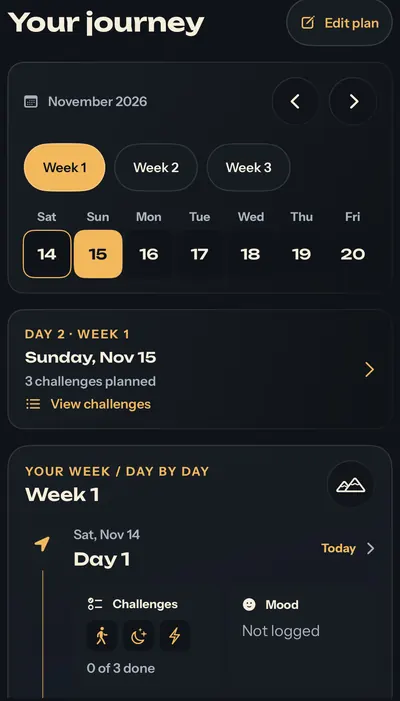
If you want the January plan built for you, Zenith: Level Up in 21 Days, an anime-inspired habit app for iPhone, turns three weeks into daily real-life challenges. It's available to pre-order on the App Store now, and Apple expects Nov 20, 2026. You earn XP as you finish challenges, your character evolves through the ranks from that earned XP, and you can edit the weeks ahead as your January changes. A mountain view shows the climb from Day 1 at the base to Day 21 at the summit, with a toggle to a day-by-day timeline. See how it works on the 21-day plan page.
Questions people ask
Is 2027 a year of reset?
Any year can be, if you plan it. There's nothing special about 2027 on its own, but researchers have found that new starts, like a new year, month or week, make people more likely to act on goals. They call it the fresh start effect. Use that bump to set up a plan, then rely on the plan when the bump fades in February.
Is it reset Sunday or Sunday reset?
Both are used online, and they mean the same thing: a weekly routine on Sunday where you clean up, plan the week, prep food and get your head straight. 'Sunday reset' is the more common phrase. A New Year reset is the big annual version, and a weekly Sunday reset is how you keep it going through January and beyond.
What are the top New Year's resolutions?
In a YouGov poll of 1,104 U.S. adults in December 2025, the top 2026 resolutions were exercising more (25%), being happier (23%), eating healthier (22%), saving more money (21%) and improving physical health (21%). Losing weight followed at 17% and improving mental health at 16%; spending more time with family was 15%. Health and money dominate every year.
What are some ideas for a reset day?
Clean and clear your room, delete apps you don't use, unsubscribe from emails, check your bank balance and subscriptions, wash your gym kit, set a wake time, plan your first training sessions, put key dates in your calendar and message one person you've lost touch with. Finish by writing three rules for the first week.
Why do New Year's resolutions fail?
Mostly because they're vague, too big or about stopping something rather than starting something. In a 2020 study of 1,066 people, approach goals ('start running twice a week') did better than avoidance goals ('stop eating junk'). Resolutions also fail when there's no plan for a bad day. A short, specific plan with a miss rule beats a big promise.
When should I start a New Year reset?
Do the reset day any time from December 27 to January 3, then start your plan on Monday, January 4, 2027. Starting on a Monday gives you a clean first week, and January 1 is a Friday, which makes a weak start easy. If you miss January 4, the first of February or any Monday is a fine fresh start.
Sources
- A large-scale experiment on New Year's resolutions: Approach-oriented goals are more successful than avoidance-oriented goalsPLOS ONE (Oscarsson, Carlbring, Andersson and Rozental), 2020
- The Fresh Start Effect: Temporal Landmarks Motivate Aspirational BehaviorManagement Science (Dai, Milkman and Riis), 2014
- Americans' New Year's resolutions for 2026YouGov, 2025-12
- Implementation intentions and goal achievement: A meta-analysis of effects and processesAdvances in Experimental Social Psychology (Gollwitzer and Sheeran), 2006
- How are habits formed: Modelling habit formation in the real worldEuropean Journal of Social Psychology, 2010
- About SleepU.S. Centers for Disease Control and Prevention, 2024