Monk mode: what it means and how to do it without cutting off your life
In short
Monk mode is a set period, usually a few weeks to a few months, where you cut distractions like social media, junk content and late nights to focus on two or three goals. It borrows the idea of a monk's focused routine, not the religion. It works best with clear rules, a fixed end date and your friends and family still in your life.
Key takeaways
- Monk mode means a fixed period of fewer distractions and more focus on two or three goals, not a permanent lifestyle.
- The rules that matter are a phone boundary, a sleep window, daily training, a daily deep-work block and a weekly review.
- Isolation is the main risk: strong social ties are linked with a 50% higher likelihood of survival in a 148-study meta-analysis.
- A 21-day monk mode is long enough to feel the difference and short enough to finish; 90 days suits a single big goal like an exam or a project.
- Come out of monk mode on purpose: keep two rules, reintroduce one thing at a time and set limits before you reinstall apps.
On this page12 sections
What does "monk mode" mean?
Monk mode means a set period where you strip out distractions and put your time into two or three goals. Think fewer apps, no late nights, daily training and long blocks of focused work. It's borrowed from the image of a monk's disciplined day. It isn't religious, and it isn't meant to be forever.
The phrase has been around online since at least the early 2000s, according to religion scholar Catherine Newell in The Revealer. It went mainstream after 2020, helped by self-help books and a huge wave of TikTok videos. Discover Magazine describes it as a lifestyle built around discipline, routine and deliberate living.
What is monk mindset?
Monk mindset is choosing depth over noise. You decide in advance what matters, protect time for it and stop reacting to every ping. It also means getting comfortable with boredom. The urge to check your phone passes if you let it.
What is the lifestyle of a monk, and how is monk mode different?
Real monastic life is a religious commitment built around prayer, work, study and living in community. Internet monk mode borrows the structure, like early starts, routine and simple living. It often drops the community part. Newell's critique is that monk mode copies the form of monastic life but loses its purpose and its people. Keep that in mind. It's the difference between a good monk mode and a lonely one.
How to activate monk mode
You activate monk mode by choosing your goals and an end date, writing a short rule list and changing your environment before Day 1. Willpower alone won't carry it.
- Pick two or three goals. Example: pass exams, train four times a week, finish a portfolio. More than three and you're just busy.
- Set an end date. 21 days is a strong first run. Put the date in your calendar.
- Write five rules (see the table below).
- Make if-then plans. "If I open my laptop, I start with my main task before email." In a meta-analysis of 94 tests, this kind of plan had a medium-to-large effect on reaching goals.
- Change the room. Log out of your worst apps, charge your phone outside the bedroom and lay out gym clothes the night before.
- Tell two people. Say what you're doing and when it ends. This keeps them in your life and keeps you honest.
Monk mode rules: the strict version vs a version you'll keep
There are no official monk mode rules. Online lists often include no social media, no alcohol, no dating, 4 a.m. starts and cutting off "distractions," friends included. Here's how to keep the useful part and drop the rest.
| Area | Strict internet version | Version that lasts |
|---|---|---|
| Phone | Delete everything | Delete or log out of your 1–2 worst apps; Focus mode during work blocks |
| Sleep | 4 a.m. alarm | Same wake time daily; teens need 8–10 hours, adults 7+ (CDC) |
| Training | Twice a day | Daily movement, 3–5 real sessions a week |
| Work | 12-hour days | One or two deep-work blocks of 60–90 minutes |
| People | Cut everyone off | Keep family and close friends; drop the group chats that drain you |
| Review | None | 10 minutes every Sunday |
The right column is still demanding. It's just built to make it to the end date.
Monk mode daily schedule examples
The best monk mode schedule fits around fixed parts of your life. Here are three versions.
Student (school or uni)
- 7:00 wake, water, 10-minute walk
- School or lectures, phone on silent in your bag
- 16:30 deep-work block: 2 × 45 minutes of study, 10-minute break
- 18:00 training or sport
- 20:00 dinner with family or housemates, phone away
- 21:30 read or review notes, no screens
- 22:30 lights out
9-to-5
- 6:30 wake, same time every day
- 7:00 one 60-minute block on your own goal before work
- Workday: email checked three times, not constantly
- 18:30 gym three to four evenings a week
- 20:00 dinner, one call or visit with a friend or family a few times a week
- 22:30 screens off
Gym beginner
- Same wake time every day
- 3 full-body sessions a week, 30–45 minutes, learning form first
- 20-minute walk on non-gym days
- Protein at two meals, one home-cooked dinner
- Lights out on time, because recovery is where training pays off
What to do with the time you free up
Monk mode fails when you remove distractions and leave a hole. The scroll comes back because nothing else is waiting. Fill the space before Day 1.
A simple way to do it is a "replacement list": for each thing you cut, write what you'll do instead in that exact moment.
| You used to… | Now you… |
|---|---|
| Scroll in bed for 40 minutes | Read 10 pages of a paper book, then lights out |
| Open YouTube after school or work | Change into training clothes and leave the house |
| Check your phone between study blocks | Stand up, drink water, do 10 push-ups |
| Spend Sunday afternoon on the couch | Meal-prep, then a long walk with a friend |
| Game until 1 a.m. | Game for one set session on Saturday, timer on |
The last row matters. Monk mode doesn't have to mean zero fun. A planned, limited session is a rule you can keep. A total ban you break on Day 4 teaches you that your rules don't count.
Five monk mode mistakes to avoid
Most monk modes fail for the same handful of reasons. Avoid these and you're ahead of most people who try it.
- Too many rules on Day 1. Ten rules at once means you'll miss three by Wednesday. Start with five and earn the rest.
- No end date. "Monk mode until I make it" quietly turns into burnout. Pick a date.
- Copying someone else's schedule. A 4 a.m. start doesn't work if your shift ends at midnight. Build around your fixed hours.
- Cutting people instead of noise. Drop the feeds, not your brother, your mates or your team.
- Treating a slip as failure. Miss a day, then get straight back on the next one. Never miss twice in a row.
How long should monk mode last?
Monk mode should last as long as your goal needs and no longer. Pick the shortest length that fits.
| Length | Good for | Watch out for |
|---|---|---|
| 1 day to a weekend | A reset after a rough week | Expecting a big change |
| 7 days | Testing your rules | Starting too strict |
| 21 days | Building a daily routine you can feel | Treating Day 22 as a free-for-all |
| 60–90 days | One big goal: exams, a launch, a training block | Drifting from friends |
| 1 year | Rarely a good idea | Isolation, burnout |
The risk nobody mentions: isolation
The biggest risk of monk mode is cutting yourself off from people. Writing in The Liberal Patriot, Nate Moore argues that many young men now treat isolation as a strength. He cites survey data that 28% of men under 30 have no close social connections.
The research on social ties is strong. A meta-analysis of 148 studies with more than 300,000 people found that people with stronger social relationships had a 50% higher likelihood of survival over the study periods. The authors compared the size of that effect to well-known risks like smoking.

See the numbers
| Number | What it means | Note |
|---|---|---|
| 148 | studies pooled | |
| 308,849 | people followed | |
| 50% | higher likelihood of survival | with stronger social relationships |
So make one rule non-negotiable: talk to at least one real person on purpose every day. Monk mode is a filter, not a wall. You're cutting noise, not people.
What are the benefits of monk mode?
The realistic benefits are more time, more focus and a clearer sense of what you actually want to spend your days on. There's no study of "monk mode" itself, but there is research on parts of it.
In a randomised experiment, Allcott and colleagues (2020) paid people to deactivate Facebook for four weeks. They spent less time online, more time with family and friends, and reported higher well-being. Many kept using Facebook less after the experiment ended. That's the core monk mode bet: less feed, more life.
Don't expect a new personality in a week. Expect quieter evenings, more finished work and a few days that feel like yours.
Monk mode vs Winter Arc vs dopamine detox
These three get mixed up online. They overlap, but each has a different centre.
| Monk mode | Winter Arc | Dopamine detox | |
|---|---|---|---|
| Main idea | Cut distractions, focus on a few goals | Use the end of the year to get ahead | Take a break from one compulsive habit |
| Usual length | Weeks to months | Oct or Nov to Dec 31 | Hours to 30 days |
| Focus | Focus and output | Training, sleep, discipline | Screens and instant rewards |
| Best for | An exam block, a launch, a project | A clear seasonal reset | Breaking a scrolling or gaming loop |
If training is your main goal, start with the Winter Arc. If your phone is the problem, start with the dopamine detox.
How to come out of monk mode
Plan your exit before you start, so Day 22 doesn't undo Day 1 to 21.
- Keep two rules for good. Usually the sleep window and the deep-work block.
- Bring things back one at a time. One app per week, with a time limit set before you reinstall it.
- Say yes to plans. Fill the first weekend after monk mode with people, not a scroll binge.
- Review. Write down what changed, what you missed and what you didn't miss at all.
A 21-day monk mode plan
Three weeks is a strong first monk mode. Each week has one job.
- Week 1, start: Phone boundary, wake time and the daily check-in. That's it.
- Week 2, rhythm: Add one deep-work block and three to four training sessions.
- Week 3, proof: Keep everything, add one stretch goal, and plan your exit.

Text version
| Step | What | Detail |
|---|---|---|
| Week 1 | Start | Phone boundary, wake time and the daily check-in. That's it. |
| Week 2 | Rhythm | Add one deep-work block and three to four training sessions. |
| Week 3 | Proof | Keep everything, add one stretch goal and plan your exit. |
| Day 22 | Exit on purpose | Keep two rules. Bring back one app a week, limit set first. |
21 days is a plan length, not a promise that the habits are locked in. Research puts the median closer to 66 days, as we explain in how long it takes to form a habit. You can sketch your own weeks with the Winter Arc planner or the 21-day plan generator, and pair this with a dopamine detox if screens are your main problem.
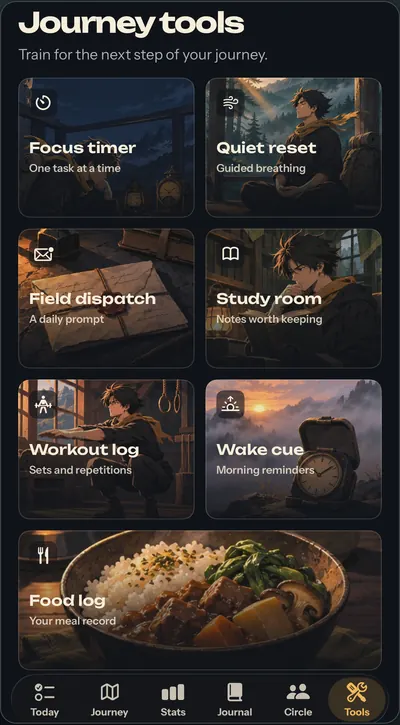
If you want the plan done for you, Zenith: Level Up in 21 Days turns three weeks into daily real-life challenges, shown as a mountain from Day 1 at the base to Day 21 at the summit. Its Focus timer and Quiet reset (guided breathing) suit deep-work blocks, and you mark each challenge done yourself. It's available to pre-order on the App Store for iPhone, and Apple expects Nov 20, 2026. It won't block apps for you, so pair it with your phone's Focus mode. You can see how the weeks work on the 21-day plan page.
Plan it with the Winter Arc Planner
Winter Arc PlannerDaily non-negotiables on a printable calendar.Free toolQuestions people ask
What does "monk mode" mean?
Monk mode means a set period where you cut out most distractions to focus on a few goals, such as fitness, study or a project. Typical rules include less or no social media, a strict sleep schedule, daily training and long focus blocks. The name borrows the image of a monk's disciplined routine. It isn't religious and it isn't meant to last forever.
How do you activate monk mode?
Pick two or three goals and an end date, then write five rules: a phone boundary, a sleep window, daily training, one deep-work block and a weekly review. Tell the people close to you what you're doing and when it ends. Delete or log out of your worst apps, set up your space the night before, and start on a Monday.
What is monk mindset?
Monk mindset is choosing depth over noise. You decide in advance what matters, protect time for it and stop reacting to every notification. It also means being comfortable with boredom and small discomfort. A good monk mindset keeps people close: real monastic life is built around community and service, not cutting yourself off.
What is the lifestyle of a monk?
Real monastic life is a religious commitment built around prayer, work, study and community, with set times for each part of the day. Internet monk mode borrows only the structure: early rising, routine, simplicity and focus. It usually drops the spiritual purpose and the community, which is why critics call it a productivity trend wearing a monk's robe.
How long should monk mode last?
As long as your goal needs and no longer. A weekend works for a reset, 21 days for building a routine, and 60 to 90 days for one big goal like an exam block or a launch. Year-long monk modes are popular online but risky, because cutting out people for months harms more than it helps. Always set an end date before you start.
Is there a monk mode app?
Many apps use the name, and most of them block websites or apps during timed focus sessions. Your iPhone's built-in Focus modes and Screen Time limits can do much of the same for free. Some people prefer a habit app that structures the day instead. Zenith: Level Up in 21 Days is one of those, and it does not block apps.
Sources
- Monk Mode: Monastic Living for the Digital AgeThe Revealer (Catherine L. Newell), 2024-02-06
- The New Viral Trend 'Monk Mode' and Everything You Need to Know About ItDiscover Magazine, 2024-01-26
- "Monk Mode" Is Destroying Young MenThe Liberal Patriot (Nate Moore), 2025-01-20
- Social Relationships and Mortality Risk: A Meta-analytic ReviewPLOS Medicine (Holt-Lunstad, Smith and Layton), 2010
- The Welfare Effects of Social MediaAmerican Economic Review (Allcott, Braghieri, Eichmeyer and Gentzkow), 2020
- Implementation intentions and goal achievement: A meta-analysis of effects and processesAdvances in Experimental Social Psychology (Gollwitzer and Sheeran), 2006
- About SleepU.S. Centers for Disease Control and Prevention, 2024