How long does it take to form a habit? What the research actually says
In short
It usually takes about two months, not 21 days. In the best-known study (Lally et al., 2010) a new daily habit took a median of 66 days to feel automatic, with a range of 18 to 254 days. A 2024 systematic review found medians of 59 to 66 days and individual times from 4 to 335 days. Simple, daily, same-cue habits get there fastest.
Key takeaways
- The 21-day figure comes from a 1960 book by plastic surgeon Maxwell Maltz, who wrote about getting used to change and said it took a minimum of about 21 days, not that habits form in 21 days.
- In Lally et al. (2010), a new daily behaviour took a median of 66 days to reach peak automaticity, with a range of 18 to 254 days, and missing one day did not derail the process.
- A 2024 systematic review (Singh et al.) found median times of 59 to 66 days, mean times of 106 to 154 days, and individual times from 4 to 335 days.
- Habits form faster when they are simple, done daily, tied to the same cue, chosen by you and, in one stretching study, done in the morning.
- Use 21 days as a finishable first block, then keep the same cue and keep going; expect real automaticity to take two to five months.
On this page11 sections
The short answer
How long does it take to form a habit? Usually about two months, and often longer. In the best-known study, a new daily habit took a median of 66 days to feel automatic. Single people ranged from 18 to 254 days.
A 2024 review of 20 studies pulled the evidence together. The studies that timed habit formation found medians of 59 to 66 days. Individual times ran from 4 to 335 days.
So the honest answer to "how many days does it take to form a habit" is: it depends on the habit and on you. Two months is a fair median. 21 days is not a rule.
Here is what the research says, where the 21-day idea came from, and how to make a habit stick faster.
Where did "21 days to form a habit" come from?
The 21-day idea comes from a plastic surgeon, not a habit study. In 1960, Maxwell Maltz published Psycho-Cybernetics. In the preface he described how long his patients took to adjust to change.
He saw that patients took about three weeks to get used to a new face. People with an amputated limb felt a "phantom limb" for about the same time. He wrote that it usually takes "a minimum of about 21 days" to see any change in a mental image, as quoted by UCL researchers who tracked down the passage.
Notice two things:
- He was talking about getting used to something (habituation), not about building a new automatic behaviour.
- He said a minimum of about 21 days, not exactly 21 days.
The book sold millions of copies. Over time, the word "minimum" fell away and the line became a slogan. James Clear's write-up traces the same drift. The UCL team put it plainly: 21 days may fit adjusting after plastic surgery, but it is unfounded as a basis for habit formation.
What is the 21 days theory?
It is the popular belief that repeating something for 21 days locks it in as a habit. It survives because it sounds doable. Three weeks feels short enough to finish. That's a real benefit, and we come back to it below. But it isn't a measured result.
What did the Lally 2010 study find?
The Lally study is the main source for the "66 days" number. Researchers at University College London asked volunteers to pick one new healthy behaviour, such as drinking a glass of water after breakfast. Each person did it once a day, after the same daily cue, and rated how automatic it felt.
The study was published in the European Journal of Social Psychology in 2010. According to the British Psychological Society's summary:
- 96 people started and 82 finished the 84-day study.
- Automaticity rose fast at first, then levelled off. Early repetitions counted most.
- The median time to reach that plateau was 66 days.
- The range was huge: 18 days for the fastest person. For the slowest, the model predicted 254 days, far past the end of the study.
- People who chose an exercise behaviour took about one and a half times as long as people who chose an eating or drinking behaviour.
- Missing one day did not materially affect habit formation. Missing many days did lower how strong the habit got.
That last point matters most in real life. One missed day is noise. A pattern of missed days is the problem.
How long is 66 days?
66 days is 9 weeks and 3 days, a little over two months. Remember it is a median: half the people who got there were faster, half were slower.
What does the newest research say?
The newest evidence agrees with Lally and widens the range. In December 2024, Ben Singh and colleagues at the University of South Australia published a systematic review and meta-analysis in Healthcare. It is also indexed on PubMed.
What they did:
- Searched six research databases for studies that measured habit strength or time to automaticity.
- Included 20 studies with 2,601 adults. Behaviours included physical activity, healthy eating, drinking water, flossing and vitamin taking.
What they found:
- Only four studies actually timed how long habits took. Their medians were 59 to 66 days and their means were 106 to 154 days.
- Individuals ranged from 4 to 335 days.
- In one healthy-eating study (Keller et al.), the median was 59 days. But only 23% of participants reached the study's habit threshold at all.
- Across 12 studies, habit strength rose clearly from before to after the programmes. The pooled effect was a standardised mean difference of 0.69, a moderate-to-large change.
- Most studies (11 of 20) were rated at high risk of bias, so the authors call the evidence "emerging".
Their verdict on 21 days is blunt. The results "clearly refute" the idea that habits form in about 21 days. They also write that brief 21-day challenges are unlikely to be enough on their own to fully ingrain a habit. For most health habits, plan on two to five months.

See the numbers
| Low | High | Marked | |
|---|---|---|---|
| Any daily habit (Lally) | 18 | 254 | median 66 |
| Healthy eating (Keller) | 4 | 335 | median 59 |
How long different habits took in the studies
Here is our summary table of every timed result in the two main sources. We only list numbers the studies report. Where a study measured habit strength but not days, we say so.
| Habit type | What the study found | Source |
|---|---|---|
| Any self-chosen daily health habit (eating, drinking or activity) | Median 66 days to peak automaticity; range 18–254 days | Lally et al., 2010 |
| Exercise vs eating or drinking habits | Exercise took about 1.5× as long to plateau | Lally et al., 2010 (BPS summary) |
| Simple vs complex behaviours | A glass of water peaked sooner than 50 sit-ups (no exact days given) | Lally et al., 2010 (UCL summary) |
| Healthy eating | Median 59 days; range 4–335 days; only 23% reached the habit threshold | Keller et al., in Singh et al., 2024 |
| Healthy eating and self-weighing (self-reported) | Mean 91 days (SD 55) | Lally et al. (earlier study), in Singh et al., 2024 |
| Daily stretching, done in the morning | Mean 106 days | Fournier et al., in Singh et al., 2024 |
| Daily stretching, done in the evening | Mean 154 days | Fournier et al., in Singh et al., 2024 |
| Flossing | Largest jump in habit strength (SMD 1.11); days not reported | Singh et al., 2024 |
| Cutting sedentary time | No significant change in habit strength (one study) | Singh et al., 2024 |
Two patterns stand out. Simple habits beat complex ones, and morning beat evening in the one study that compared them.
Habit calendar: when the research milestones land
If you start a new daily habit on 1 January 2027 (counting that as day 1), here is when each number lands.
| Day | Date | Weeks | What it means |
|---|---|---|---|
| 21 | Thu 21 Jan | 3 | The popular myth; a good first checkpoint |
| 59 | Sun 28 Feb | 8.4 | Median in the healthy-eating study |
| 66 | Sun 7 Mar | 9.4 | Median in Lally et al. |
| 106 | Fri 16 Apr | 15.1 | Mean for morning stretching |
| 154 | Thu 3 Jun | 22 | Mean for evening stretching |
| 254 | Sat 11 Sep | 36.3 | Slowest predicted case in Lally et al. |
Use it to set expectations, not deadlines. If your habit still needs effort on 21 January, nothing is wrong. You are on schedule.

See the numbers
| Value | |
|---|---|
| Popular 21-day claim | 21 days |
| Median, healthy eating | 59 days |
| Median, Lally et al. | 66 days |
| Mean, morning stretching | 106 days |
| Mean, evening stretching | 154 days |
| Slowest case, Lally et al. | 254 days |
What makes a habit form faster or slower?
Habits form faster when the behaviour is simple, repeated daily, tied to a stable cue and your own choice. The reviews point to five levers.
- Complexity. A glass of water automates sooner than a workout. In Lally's study, exercise took about 1.5 times as long. Start smaller than you think you need.
- Consistency. Early repetitions add the most automaticity. Doing it daily in the first weeks matters more than doing it perfectly.
- A stable cue. Habits are learned links between a situation and an action. People who did the behaviour in the same context built stronger habits. In a 2015 study, cues tied to an existing event raised automaticity. Phone reminders helped people repeat the action but did not build the habit itself.
- Choice and enjoyment. Self-chosen habits came out stronger than assigned ones. Enjoying the behaviour also helped.
- Reward and timing. Simple behaviours with clear cues and quick rewards automate more easily, the Singh review notes. In the one stretching study that compared times of day, morning beat evening.
What slows a habit down: a fuzzy cue ("sometime today"), a big first step, a different time every day and long gaps.
The fastest way to get a stable cue is to attach the new habit to something you already do. That's habit stacking, and it is the simplest version of this research in practice.
What is the 21-90 rule?
The 21/90 rule says: do a behaviour for 21 days to build a habit, then keep it for 90 days to make it a lifestyle. It is folk advice. The 21 comes from the misread Maltz line, and we could not find a study behind the 90.
That said, the shape of it isn't crazy. A short first block, then a longer stretch to make it stick, roughly matches the data. Most timed medians sit around two months. Just don't treat either number as a pass or fail line.
Is 21 days enough to break a habit?
There is no good number for breaking a habit. The studies above timed new habits forming, not old ones fading. What the research does show is that cues drive automatic behaviour. So to break a habit, change or remove the cue: where you are, when it happens, what sets it off. Then put a new behaviour on that cue. Three weeks without the old habit is a good start. It isn't proof the urge is gone.
What does this mean for a 21-day challenge?
A 21-day challenge is a good way to start a habit, not to finish one. Three weeks is long enough to stack up real repetitions, and early repetitions count most. It's short enough that you can see the finish line, which helps you show up.
The mistake is expecting the habit to run on autopilot on day 22. The research says to keep going with the same cue for another one to four months. A practical plan:
- Days 1–21: one small habit, same cue, every day. Don't add a second habit yet.
- Day 21: review honestly. Does it take less effort than day 1? Is the cue reliable?
- Days 22–66: keep the cue fixed. Make the habit slightly bigger only if it still feels easy.
- After day 66: if it still feels like work, it's not failing. You may be on the slow side of the range.
If you want structure for those first three weeks, the 21-day plan generator builds one around your routine. For staying on track after that, see our guide to how to stay consistent.
Why Zenith still uses 21-day plans
We build Zenith: Level Up in 21 Days, so here's the honest version. 21 days is how our plan is structured, not a scientific promise. The research above says real habits often take two months or more, and we agree.
We still use 21 days because a plan you finish beats a plan you quit. Three weeks is a finishable first climb. Week 1 is about proving you can start. Week 2 is about finding your rhythm. Week 3 is proof: you look back at the climb. Each week you can edit or delete the challenges still ahead, so the plan can match the simple, cue-based habits that research favours.
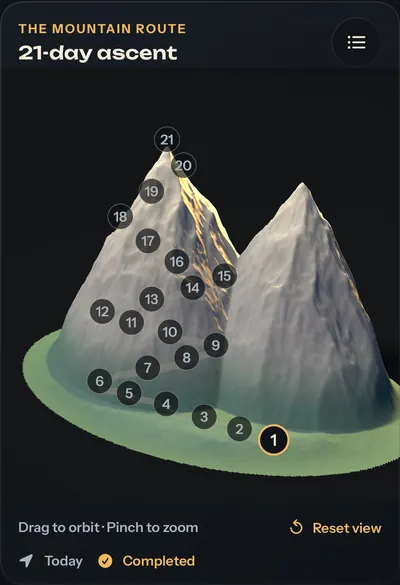
The app, available to pre-order on the App Store (Apple expects Nov 20, 2026), makes showing up easier and shows your effort adding up: XP and streaks, a character that evolves through the ranks from earned XP, and a 3D mountain that runs from Day 1 at the base to Day 21 at the summit. The showing up is still yours, and day 21 is a checkpoint, not a finish line. See how the 21-day plan works.
The bottom line
- Expect about two months, with a wide range. Some habits take far longer.
- The 21-day figure is a myth built on a misread "minimum".
- Make the habit small, tie it to a stable cue, do it daily and don't panic after one missed day.
- Use short challenges to start, then keep the same cue going until the habit runs without you thinking about it.
Data on how other apps use these numbers is in our study of 60 level-up apps: the most common plan length there is 66 days, not 21. And if you're wondering whether streaks and XP help, read our evidence review on whether gamified habit apps work.
Questions people ask
Does it really take 21 days to develop a habit?
No study supports a fixed 21 days. The number traces back to Maxwell Maltz's 1960 book Psycho-Cybernetics, where he said people need a minimum of about 21 days to adjust to a change. When researchers timed habit formation, the median was 59 to 66 days and individuals ranged from 4 to 335 days. Some simple habits can click sooner; most take longer.
What is the 21-90 rule?
The 21/90 rule is popular advice: do something for 21 days to build a habit, then 90 days to make it part of your lifestyle. It is folk wisdom, not a research finding. The 21 comes from a misread 1960 book, and we found no study behind the 90. The two numbers are fine as checkpoints, as long as you don't treat them as deadlines.
How many days does it take to form a habit on average?
In the studies that measured it, the median was 59 to 66 days, roughly two months. Averages were longer, 106 to 154 days in a stretching study, because a few slow cases pull the mean up. A 2024 review concluded that most health habits need about two to five months to become automatic, and that the range between people is huge.
What is the 21 day rule in psychology?
It is the claim that a new habit forms in 21 days. It isn't an established psychology finding. It comes from Maxwell Maltz, a plastic surgeon who noticed patients took at least about three weeks to get used to a new face. Habit researchers at UCL call the 21-day figure a myth; their own study found a median of 66 days.
Is 21 days enough to break a habit?
Probably not on its own. Habit research mostly times new habits, not breaking old ones, so there is no reliable number for quitting. What the studies do show is that context drives automatic behaviour, so changing the cue (where, when, what triggers it) matters more than counting days. Treat three weeks as a start, not proof the old habit is gone.
How long is 66 days?
66 days is 9 weeks and 3 days, a little over two months. If you start on 1 January, day 66 lands on 7 March. It is the median time to peak automaticity in Lally et al. (2010), so about half the people in that study got there sooner and half later, some of them much later.
Does missing a day ruin a new habit?
No. In Lally et al. (2010), missing one opportunity to do the behaviour did not materially affect habit formation. What hurt was missing often: many skipped repetitions lowered how automatic the habit eventually became. So if you miss a day, do the habit at the next cue and move on. Don't restart from zero.
Sources
- How are habits formed: Modelling habit formation in the real world (Lally, van Jaarsveld, Potts & Wardle)European Journal of Social Psychology, 40, 998–1009, 2010
- Time to Form a Habit: A Systematic Review and Meta-Analysis of Health Behaviour Habit Formation and Its Determinants (Singh, Murphy, Maher & Smith)Healthcare (MDPI), 12(23), 2488, 2024-12-09
- Time to Form a Habit (PubMed record 39685110)PubMed, U.S. National Library of Medicine, 2024
- Busting the 21 days habit formation myth (Gardner & Meisel)UCL Health Behaviour Research Centre blog, 2012-06-29
- How to form a habit (summary of Lally et al., 2010)The British Psychological Society, Research Digest
- How Long Does it Actually Take to Form a New Habit? (Backed by Science)James Clear
- Beyond self-tracking and reminders: designing smartphone apps that support habit formation (Stawarz, Cox & Blandford)CHI 2015 Proceedings, ACM, 2015