Do habit trackers and gamified habit apps actually work?
In short
Yes, but modestly. Tracking your progress helps you reach goals, with a small-to-medium effect across 138 experiments. Gamified physical-activity programmes beat no programme and slightly beat non-gamified ones, but the effect shrinks once the game stops. Feedback, goals and friendly competition help; heavy rewards, broken-streak messages and punishment can backfire.
Key takeaways
- Do habit trackers work? Monitoring goal progress improved goal attainment in a meta-analysis of 138 experiments (d = 0.40), more so when progress was written down or shared.
- A 2022 meta-analysis of 16 randomised trials found gamified programmes raised physical activity (g = 0.42), but only slightly more than non-gamified programmes (g = 0.23).
- Effects fade: in that meta-analysis the effect fell to g = 0.15 at follow-up, and in the STEP UP trial activity dropped in every gamified group once the game ended.
- Feedback, clear goals and social comparison have the best support; expected rewards can undermine intrinsic motivation, and a visibly broken streak lowers later engagement.
- Use a tracker as feedback for a habit tied to a stable cue, not as the reason you do the habit.
On this page10 sections
Do habit trackers work? The short answer
Do habit trackers work? Yes, modestly, and mostly while you keep using them. Tracking your progress is one of the best-supported tools in behaviour change. Adding game elements (points, levels, streaks, competition) gives a small extra push on top.
But the effects are smaller than app store pages suggest, and they shrink once the game stops. A few popular mechanics can also backfire. This review covers what the research says, what helps, what hurts, and how to use a tracker so the habit outlasts the app.
What does "gamify" mean?
To gamify something means adding game elements to an activity that isn't a game. Researchers define gamification as the use of game elements in non-game contexts. That's the definition used in the 2022 meta-analysis by Mazeas and colleagues.
In habit apps, that usually means:
- XP or points for each completed habit
- Levels or ranks that rise as points add up
- Streaks that count days in a row
- Quests or challenges with a clear goal
- Leaderboards or friend comparisons
- Badges, cards or items you unlock
A plain habit tracker is a checklist with a history. A gamified one wraps that checklist in a progress system.
Does tracking your habits help? The self-monitoring evidence
Yes. Watching your own progress is a real, measurable help. The biggest review is a 2016 meta-analysis in Psychological Bulletin by Harkin and colleagues.
- It pooled 138 experiments with 19,951 people. Each one randomly assigned people to monitor their goal progress or not.
- Interventions that got people monitoring more often improved goal attainment (d = 0.40). That's a small-to-medium effect.
- Effects were bigger when progress was physically recorded (written or logged) and when it was reported to someone else or made public.
So the core of every habit tracker, logging what you did, has solid support.
The catch: tracking helps you repeat, not automate
A tracker reminds you and counts. That gets the reps in. But a habit is a behaviour that starts automatically from a cue. In a 2015 study, Stawarz and colleagues tested both. Phone reminders helped people repeat a behaviour but got in the way of it becoming automatic. Cues tied to an existing daily event did build automaticity. The same team reviewed 115 habit apps and found most relied on tracking and reminders.
The fix is simple: track the habit, but trigger it with a real-life cue, not a notification. That's what habit stacking does.
Do gamified habit apps work? The meta-analysis evidence
The best evidence comes from physical activity, because steps are easy to measure. The Mazeas et al. (2022) meta-analysis in the Journal of Medical Internet Research is the key study.
- 16 randomised controlled trials, 2,407 participants, published 2010–2020.
- Gamified programmes increased physical activity with a small-to-medium effect (Hedges g = 0.42).
- Against no programme (for example a waiting list), the effect was g = 0.58.
- Against a non-gamified programme doing the same job, the effect was smaller, g = 0.23.
- At follow-up, on average 14 weeks after programmes ended, the effect dropped to g = 0.15, very small to small.
- Results held across adults and teens, and for people with and without chronic conditions.
The authors read the follow-up result as evidence that gamification is more than a novelty effect. That's fair: the effect didn't vanish. But it did shrink to about a third.

See the numbers
| Value | |
|---|---|
| vs no programme | g = 0.58 |
| Overall | g = 0.42 |
| vs non-gamified programme | g = 0.23 |
| Follow-up, ~14 weeks after | g = 0.15 |
An earlier 2016 systematic review by Johnson and colleagues found 19 studies on gamification for health and wellbeing. 59% reported positive effects and 41% mixed effects. The quality of evidence was mostly moderate or lower. The authors flagged a big gap: many studies didn't compare a gamified version with a plain version of the same programme.
What one large trial shows about game design
The STEP UP trial (Patel et al., 2019) tested a 24-week game with points and levels for hitting step goals. It enrolled 602 adults across 40 U.S. states, all wearing step trackers.
| Group | Extra daily steps vs control during the game | Extra daily steps in the 12 weeks after |
|---|---|---|
| Competition | 920 | 569 (still significant) |
| Support | 689 | 428 (not significant at the trial's threshold) |
| Collaboration | 637 | 126 (not significant) |
All three versions worked while the game ran. Competition worked best. Once the game stopped, activity dropped in every group, and only the competition group stayed clearly ahead of the control group.

See the numbers
| Value | |
|---|---|
| Competition, during | +920 steps |
| Competition, after | +569 steps |
| Support, during | +689 steps |
| Support, after | +428 steps |
| Collaboration, during | +637 steps |
| Collaboration, after | +126 steps |
What works in gamified habit apps
The elements with the best evidence are the plain ones: feedback, clear goals and some social comparison.
- Feedback on progress. Monitoring improved goal attainment across 138 experiments. Positive feedback also boosted motivation in Deci's reward meta-analysis (d = 0.33 for free-choice behaviour).
- Clear, specific goals. STEP UP had people choose a step-goal increase, then earn points and levels for hitting it.
- Recording it. Physically logging progress gave bigger effects than keeping it in your head.
- Sharing it. Reporting progress to someone, or in public, gave bigger effects in Harkin's review. In STEP UP, competition beat support and collaboration.
- A real-life cue. Event cues build automaticity better than reminders.
What backfires in gamified habit apps
Three mechanics can work against you.
Rewards that crowd out your own reasons
A classic 1999 meta-analysis by Deci, Koestner and Ryan pooled 128 experiments. Expected rewards for doing, finishing or performing an activity lowered people's own interest in doing it freely afterwards. The effect sizes were d = −0.40, −0.36 and −0.28 for those three reward types. This is often called the overjustification effect.
For habit apps the lesson is: if the XP becomes the only reason you train, the habit is fragile. Use points as feedback, not as payment.
Broken-streak messages
Streaks are powerful in both directions. Silverman and Barasch (2023) ran seven studies. Seeing an intact streak in a log increased later engagement. Seeing a broken one lowered it. It mattered how the log showed the past, not only what people had actually done. The drop was bigger when people blamed themselves, and smaller when they could repair the streak.
Compare that with the habit science. In Lally's 2010 study, missing one day did not materially affect habit formation. So an app that shows "streak lost: 0 days" after one miss can push you to quit a habit that was still on track.
Novelty that wears off
New games are exciting; old ones aren't. The meta-analysis effect fell from g = 0.42 to g = 0.15 at follow-up. STEP UP saw activity drop in every arm once the game ended. Plan for the shine to fade. Keep the game light, and keep the cue doing the heavy lifting.
Evidence scorecard: what helps vs what hurts
| Mechanic | Evidence direction | How strong | Use it like this |
|---|---|---|---|
| Logging progress | Helps | Strong (138 experiments) | Log right after the habit, every time |
| Feedback (charts, XP as information) | Helps | Moderate | Look at weekly totals, not just today |
| Social comparison, competition | Helps while it runs | Moderate (one large RCT, PA only) | Small private group, weekly totals |
| Points and levels | Small extra help | Moderate (16 RCTs, PA only) | Fine as feedback, not as the reason |
| Streaks | Helps when intact, hurts when broken | Moderate (7 studies, mostly not habit apps) | Prefer apps that let you recover a miss |
| Expected rewards and prizes | Can undermine motivation | Strong (128 experiments, mostly lab tasks) | Keep rewards small, about progress |
| Phone reminders | Help repetition, can slow automaticity | Limited (one study) | Use a real-life cue instead |
| Penalties for missed days | Untested in the studies we found | No direct evidence | Optional at most; don't reset to zero |
"How strong" is our judgement from the size and number of studies cited above.
How common are these mechanics in real apps?
We checked. In our study of 60 level-up and discipline apps on the U.S. App Store, 57% of descriptions mention streaks and 52% mention XP. Only 12% describe any way to recover from a missed day. 13% mention penalties or punishments, and 20% mention leaderboards or competing with other users.
How to use a habit tracker so it actually works
- Pick one habit and tie it to a daily cue: "After I close my laptop, I do ten push-ups."
- Log it immediately after the cue, in an app or on paper. The habit tracker template works offline.
- Review weekly. Count the week, not the streak.
- Share the weekly number with one friend or a small group.
- If you miss a day, do it at the next cue. Don't restart from zero.
- Expect it to take months. Habits take a median of about two months to feel automatic. See how long it takes to form a habit.
For a points-and-levels setup without an app, our life RPG guide walks you through it. Comparing apps instead? See the best habit tracker apps for iPhone.
How we used this research in Zenith
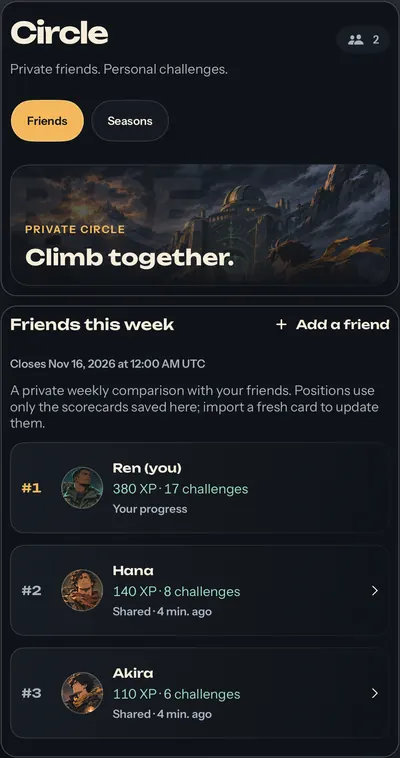
We make Zenith: Level Up in 21 Days, so here's where this research shaped it, and where it doesn't settle anything. Zenith uses XP, streaks and ranks as feedback on real-life challenges you mark done yourself, and you can skip or undo a challenge. Your character evolves through the ranks only from earned XP, and an optional private photo on a finished challenge adds +5 XP once as a personal record, not as AI verification or proof. Comparison is private: you share weekly scorecards with friends you invite, with no global leaderboard or public feed. Achievement cards are earned, never bought. None of that makes Zenith proven by these studies, and it isn't out yet: it's available to pre-order on the App Store, and Apple expects Nov 20, 2026. The research supports the ingredients, not any one app, and the showing up is still yours.
Questions people ask
Do habit trackers actually work?
They help, modestly. A meta-analysis of 138 experiments found that monitoring your progress improved goal attainment (d = 0.40), with bigger effects when progress was physically recorded or shared. But tracking mainly helps you repeat a behaviour. A 2015 study found reminders supported repetition while getting in the way of automaticity, so pair a tracker with a stable daily cue.
Do gamified habit apps work better than normal habit trackers?
Slightly, in the evidence we have. In a 2022 meta-analysis, gamified physical-activity programmes beat non-gamified programmes with a small effect (g = 0.23). There are few head-to-head trials of consumer habit apps, and a 2016 review noted most studies did not compare gamified and non-gamified versions. Treat claims that game mechanics transform habits with caution.
What does gamify mean?
To gamify something means adding game elements, such as points, levels, badges, streaks, quests or leaderboards, to an activity that isn't a game. Researchers define gamification as the use of game elements in non-game contexts. A gamified habit app gives you XP or ranks for real-world actions like a workout or study session.
What is the best app for tracking habits and tasks?
It depends on how you like to work. If you want a plain checklist, a simple habit tracker is enough. If points and levels keep you going, a gamified app may suit you better. We compare current iPhone options with ratings and prices in our best habit tracker apps guide, and gamified ones in our gamified habit trackers guide.
Do streaks help or hurt habits?
Both. Research by Silverman and Barasch (2023) found that seeing an intact streak in a log increases later engagement, while seeing a broken one lowers it. The drop was smaller when people could repair the streak. Since missing one day barely affects habit formation, a tracker that lets you recover from a miss fits the evidence better than one that resets you to zero.
How do I gamify my life without an app?
Pick one or two habits, tie each to an existing daily cue, and give yourself points you log on paper or in a spreadsheet. Set a weekly target, share your weekly total with a friend, and review it every Sunday. Keep the rewards small and about progress, not prizes. Our life RPG guide shows a full setup.
Sources
- Evaluating the Effectiveness of Gamification on Physical Activity: Systematic Review and Meta-analysis of Randomized Controlled Trials (Mazeas, Duclos, Pereira & Chalabaev)Journal of Medical Internet Research, 24(1), e26779, 2022-01-04
- Does monitoring goal progress promote goal attainment? A meta-analysis of the experimental evidence (Harkin et al.)Psychological Bulletin, 142(2), 198–229 (White Rose Research Online), 2016
- Gamification for health and wellbeing: A systematic review of the literature (Johnson et al.)Internet Interventions, 6, 89–106, 2016
- Effectiveness of Behaviorally Designed Gamification Interventions With Social Incentives for Increasing Physical Activity: The STEP UP Randomized Clinical Trial (Patel et al.)JAMA Internal Medicine, 179(12), 1624–1632, 2019
- A meta-analytic review of experiments examining the effects of extrinsic rewards on intrinsic motivation (Deci, Koestner & Ryan)Psychological Bulletin, 125(6), 627–668, 1999
- On or Off Track: How (Broken) Streaks Affect Consumer Decisions (Silverman & Barasch)Journal of Consumer Research, 49(6), 1095–1117 (University of Colorado Boulder summary), 2023
- Beyond self-tracking and reminders: designing smartphone apps that support habit formation (Stawarz, Cox & Blandford)CHI 2015 Proceedings, ACM, 2015
- How to form a habit (summary of Lally et al., 2010)The British Psychological Society, Research Digest