Life RPG: how to turn your life into a game
In short
A life RPG is a system that treats your real life like a role-playing game: your habits become daily quests, finishing them earns XP, XP raises your level, and stats like Strength or Intellect show where you are growing. You can build one free on paper, in Notion or in Google Sheets, or use an app. It works best as feedback, not as the only reason you show up.
Key takeaways
- A life RPG turns habits into quests worth XP, with levels and stats that make slow progress visible.
- A simple DIY version needs only a quest list, an XP value per quest, a running total and a level formula such as total XP divided by 100, plus one.
- A 2022 meta-analysis of 16 randomized trials found gamified programs had a small-to-medium positive effect on physical activity.
- Effects can fade when the game stops, and expected rewards can crowd out real interest, so keep rewards as feedback and keep the quests meaningful.
- Apps like Habitica, Arise and Zenith do the scoring for you, each with a different focus and price.
In this guide7 sections
What is a life RPG?
A life RPG is a way of running your real life like a role-playing game. Your habits become quests, finishing them earns XP, XP raises your level, and stats show which parts of you are getting stronger. People also call it gamifying your life, or a real-life RPG.
Why bother? Real progress is slow and invisible. Ten gym sessions do not show in the mirror. Twenty study blocks do not show on a report card yet. A life RPG gives you something that moves every single day: a number going up. That small hit of visible progress makes it easier to show up on the days you do not feel like it.

Text version
| Step | What | Detail |
|---|---|---|
| Do | Quest | A real action: train, study, call a friend. |
| Score | XP | Easy +10, steady +20, hard +40. |
| See | Level and stats | Total XP sets your level. Each quest feeds one stat. |
| Sunday | Weekly review | Shrink skipped quests, toughen easy ones. |
How to gamify your life in 6 steps
You can set this up in under an hour. Do not spend longer than that. Building the system is not the same as playing it.
Step 1: Pick your stats
Choose four to six stats, each tied to a real area of your life. Each quest will feed one stat.
| Stat | Real-life area | Example quests |
|---|---|---|
| Strength | Training, sport, movement | Train 30 minutes, walk 8,000 steps |
| Intellect | Study, reading, learning | 25-minute study block, read 10 pages |
| Craft | Skills and projects | 30 minutes on guitar, code, art or a side business |
| Wealth | Money habits | Log spending, move $5 to savings |
| Charisma | People | Call a friend, plan something with family |
| Discipline | Sleep and routine | Up at target time, phone out of the bedroom |
If you cannot name a real quest for a stat, drop it. Fewer stats you actually use beat a full character sheet you ignore. Not sure which area is weakest? The free starting rank test asks six quick questions and suggests where to focus first.
Step 2: Set a main quest
Your main quest is the one big goal for the next few weeks: pass an exam, run a 5K, save $300, get your first client. Every daily quest should either feed it or keep your basics steady.
Step 3: Turn habits into daily quests with XP
Write four to six daily quests. Give each an XP value by difficulty, not by how virtuous it sounds:
- Easy (+10 XP): under 10 minutes, low effort. Make the bed, drink water, read 5 pages.
- Steady (+20 XP): 15 to 30 minutes of real effort. Study block, walk, money check.
- Hard (+40 XP): the one you avoid. A full workout, the difficult assignment, the awkward phone call.
Weight XP toward hard quests. Otherwise you will farm easy points and feel productive while avoiding the thing that matters.
Step 4: Add levels
Use a simple formula: level = total XP ÷ 100, rounded down, plus 1. Zero XP is level 1. 250 XP is level 3. If you level up too fast, make each level cost more (for example, level 2 needs 100 XP, level 3 needs 200 more, and so on).
Step 5: Add side quests and boss fights
- Side quests are optional one-offs for variety: something new, a little bold, cheap. Worth +40 XP. Our list of 100 real-life side quests has plenty.
- Boss fights are big one-time challenges tied to your main quest: an exam, a race, a job interview. Worth +100 XP or more, with prep quests leading up to them.
Step 6: Run a weekly review
Every Sunday, spend ten minutes on three questions. Which quests did I skip most? Make them smaller or move them. Which were too easy? Lower their XP or make them harder. Did my real life improve this week? That last question is the one that matters.
A sample week
Here is a real-looking first week with four daily quests: up by 7:00 (+10), train 30 minutes (+40), study 25 minutes (+20), read 10 pages (+10). A perfect day is 80 XP.
| Day | Quests done | XP today | Total XP | Level |
|---|---|---|---|---|
| Mon | All four | 80 | 80 | 1 |
| Tue | Up, study, read | 40 | 120 | 2 |
| Wed | All four | 80 | 200 | 3 |
| Thu | Up, train | 50 | 250 | 3 |
| Fri | Up, study, read | 40 | 290 | 3 |
| Sat | Up, train, side quest | 90 | 380 | 4 |
| Sun | Up, read, weekly review (+20) | 40 | 420 | 5 |
Notice what the table shows: no perfect week, three missed workouts, and still clear progress. That is the point. Missed days cost XP, not the whole game.

See the numbers
| Series | Day 1 = Monday | Total XP (level = XP ÷ 100, rounded down, + 1) |
|---|---|---|
| Total XP | 1 | 80 |
| Total XP | 2 | 120 |
| Total XP | 3 | 200 |
| Total XP | 4 | 250 |
| Total XP | 5 | 290 |
| Total XP | 6 | 380 |
| Total XP | 7 | 420 |
DIY life RPG: paper, Notion or Google Sheets
You do not need an app to start. Pick whichever tool you will actually open every day.
Paper. Draw a grid: quests down the side, days across the top, XP in the last column. Tick boxes, add the day's XP at night, and keep a running total in the corner. Stick it on the wall. Our habit tracker template builds a printable 21- or 30-day grid with XP per habit, so you can skip the drawing.
Google Sheets or Excel. Put XP values in row 2, quests in columns B to E, and one row per day with checkboxes.
- Daily XP:
=SUMPRODUCT(B3:E3*B$2:E$2) - Total XP:
=SUM(F3:F23) - Level:
=INT(G1/100)+1
Notion. Make a database with one row per day and a checkbox property per quest. Add a formula property for XP, such as if(prop("Train"), 40, 0) + if(prop("Study"), 20, 0), then a rollup or sum view for your total.
Keep it plain. Fancy dashboards are fun to build and easy to abandon.
Does gamifying your life actually work?
The honest answer: it helps, especially early on, but it is not magic, and the effect can fade when the game stops.
What the research says:
- A modest, real effect. A 2022 meta-analysis of 16 randomized trials (2,407 participants) found gamified programs increased physical activity with a small-to-medium effect, and did slightly better than non-gamified programs.
- It can fade. In the STEP UP trial of 602 adults, points-and-levels games raised daily steps during the 24-week game. After the game ended, activity dropped in every group, and only the competition group stayed clearly above the control group.
- Expected rewards can backfire. A meta-analysis of 128 studies found that expected tangible rewards tended to reduce people's own interest in an activity, while positive feedback increased it.

See the numbers
| Value (steps) | |
|---|---|
| Competition, during game | +920 |
| Competition, after | +569 |
| Support, during game | +689 |
| Support, after | +428 |
| Collaboration, during game | +637 |
| Collaboration, after | +126 |
What that means for your life RPG:
- Treat XP as feedback, not payment. It shows progress. It is not the reason.
- Pick quests you actually care about. Gamifying something you hate rarely lasts.
- Plan for the game ending. After a few weeks, the goal is for the habit to run on its own. Habits often take longer than people expect: one habit study found a median of 66 days.
- Watch for point-farming. If your level rises and your life does not, change the quests.
For a deeper look at the evidence, see our research on whether gamified habit apps work.
How to keep a life RPG going after week three
Most life RPGs die in week three or four, when the novelty wears off. That is normal. Plan for it.
- Start a new season. Every three or four weeks, reset the board: keep your level, but rewrite the quest list. New quests bring back some of the novelty without starting from zero.
- Retire quests that became automatic. If you make your bed every day without thinking, it no longer needs XP. Swap it for something harder. That is what leveling up really means.
- Raise the difficulty, not the number of quests. Six quests you finish beat twelve you skim. Make a steady quest hard instead of adding new ones.
- Add a friend. Compare weekly totals with one or two friends who are running their own version. Keep it private and friendly. The goal is company, not a ranking.
- Keep a log of real-world wins. Next to your XP, write one line a week about what changed: a lift went up, a grade improved, money saved. When the numbers feel pointless, that log reminds you why you started.
If the game stops working entirely, that is fine too. The habits you built while playing are what count.
Life RPG apps that do it for you
If you would rather not build it yourself, several apps handle the scoring. Details below were checked on the U.S. App Store on 14 Nov 2026.
- Habitica: Gamified Taskmanager (HabitRPG, Inc). Turns your tasks and habits into a retro RPG. Free with in-app purchases, including an optional subscription listed at $4.99 a month. Good if you want a full game feel and like customizing everything.
- Arise: Level Up Workout Game (DIGITAL LIONS APPS). Builds a workout plan from lifestyle questions and turns training into daily quests and rewards. Free to install, but the listing says a subscription is needed for plans, quests and main features. Good if fitness is your main quest.
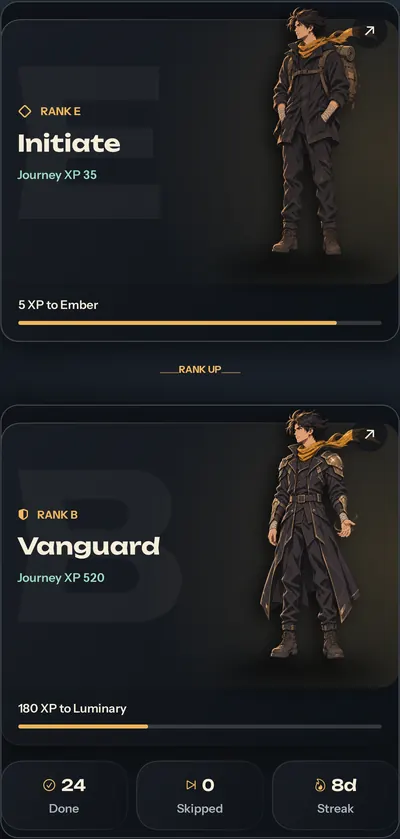
- Zenith: Level Up in 21 Days (iPhone, available to pre-order on the App Store; Apple expects Nov 20, 2026; listed there as Level Up in 21 Days: Zenith). Turns a 21-day plan into short real-world daily challenges with XP and streaks, starting from a free assessment and plan preview. Your character evolves from E Initiate to S Ascendant as you earn XP, and a stats radar shows the XP you have earned in six pillars, a bit like a life RPG stat sheet. Paid options are $12.99 a month, $59.99 a year or $69.99 lifetime (U.S. prices in USD), with no free trial. It is iPhone-only, does not track workouts or sleep automatically, and keeps data on your device. Good if you want a finishable three-week structure across several areas of life.
Comparing more options? Our guide to the best gamified habit trackers goes app by app.
Whichever route you pick, the rule is the same: the game is there to make showing up easier. The showing up is still yours.
Questions people ask
What is a life RPG?
A life RPG is a way of treating real life like a role-playing game. You turn habits and goals into quests, give each quest an XP value, and level up as your XP grows. Many people add stats such as Strength, Intellect or Charisma that rise with related quests. It can be a notebook, a spreadsheet or an app. The point is to make slow progress visible.
How do I gamify my life for free?
Write down 4 to 6 daily quests, give each an XP value (easy 10, steady 20, hard 40), and tick them off on a printed grid or a spreadsheet. Add up your XP each day and set your level as total XP divided by 100, rounded down, plus one. Review weekly and swap quests that are too easy or too hard. Paper and Google Sheets cost nothing.
Is there an app that turns your life into an RPG?
Yes, several. Habitica is a free app with in-app purchases that turns tasks into a retro role-playing game. Arise: Level Up Workout Game focuses on gamified workout plans with daily quests and needs a subscription for its main features. Zenith: Level Up in 21 Days, available to pre-order on the App Store for iPhone (Apple expects Nov 20, 2026), turns a 21-day plan into daily real-world challenges with XP and a character that evolves through ranks.
Does gamifying your life actually work?
It can help, especially at the start. A 2022 meta-analysis of 16 randomized trials found gamified programs increased physical activity with a small-to-medium effect. But a large trial found the boost shrank once the game ended. Gamification works best as feedback that makes progress visible, attached to habits you already care about, rather than as the only reason you act.
What stats should I track in a life RPG?
Keep it to four to six stats tied to real areas of your life. A common set: Strength for training, Intellect for study and reading, Craft for skills and projects, Wealth for money habits, Charisma for time with people, and Discipline for sleep and routine. Each quest feeds one stat. If you cannot name a quest for a stat, drop the stat.
Can gamifying your life backfire?
Yes, in a few ways. You can start chasing points instead of results, padding your list with easy quests. Rewards you expect for doing something can reduce how much you enjoy it for its own sake. And building the system can become procrastination. Keep the setup under an hour, weight XP toward hard quests, and ask weekly whether your real life actually improved.
Sources
- Evaluating the Effectiveness of Gamification on Physical Activity: Systematic Review and Meta-analysis of Randomized Controlled TrialsJournal of Medical Internet Research (Mazeas et al.), 2022
- Effectiveness of Behaviorally Designed Gamification Interventions With Social Incentives for Increasing Physical Activity (STEP UP trial)JAMA Internal Medicine (Patel et al.), 2019
- A meta-analytic review of experiments examining the effects of extrinsic rewards on intrinsic motivationPsychological Bulletin (Deci, Koestner & Ryan), 1999
- How are habits formed: Modelling habit formation in the real worldEuropean Journal of Social Psychology (Lally et al.), 2010
- Habitica: Gamified Taskmanager (U.S. App Store listing, checked 14 Nov 2026)Apple App Store, 2026-11-14
- Arise: Level Up Workout Game (U.S. App Store listing, checked 14 Nov 2026)Apple App Store, 2026-11-14