The app
The 21-day plan
In short
The Zenith 21-day plan is three weeks of daily real-life challenges built from your assessment and shown as a 3D mountain, Day 1 at the base and Day 21 at the summit. You can edit the weeks ahead. 21 days is how the plan is structured, not a scientific promise: research found a median of 66 days for habits to feel automatic.
Key takeaways
- Your plan is built on your iPhone from your assessment answers, by a planner that follows fixed rules, with no AI.
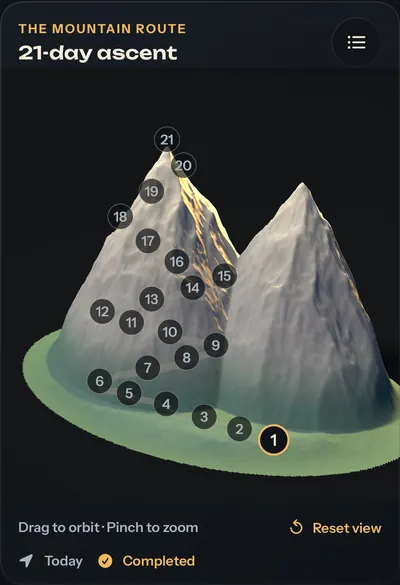
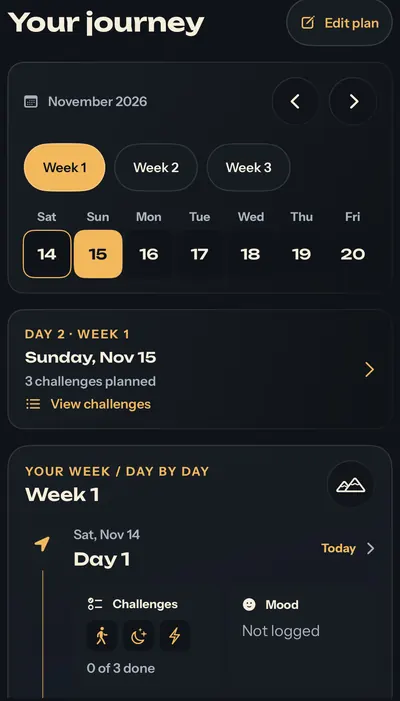
- In the app, the plan is a 3D mountain from Day 1 at the base to Day 21 at the summit, with a toggle to a day-by-day timeline.
- Edit plan lets you change the weeks ahead, delete challenges, set reminders and preview future days, while today and past records stay protected.
- 21 days is a plan format, not a claim that habits form in 21 days; in Lally et al. (2010) the median was 66 days, with a range of 18 to 254.
- The plan preview is free, so you see your three weeks before you pay.
On this page8 sections
What is the Zenith 21-day plan?
The 21-day plan is three weeks of daily real-life challenges, built from a short assessment of your priorities and how much you can realistically take on. You do each challenge, mark it done yourself, and watch your saved XP, streak and character add up.
The planner runs on your iPhone and follows fixed rules, so the same answers give the same plan. No AI is involved. You see the plan before you pay: the assessment and the 21-day plan preview in Zenith: Level Up in 21 Days are both free.
Your plan as a mountain
In the app, the Journey tab shows your 21 days as a 3D mountain. Day 1 sits at the base. Day 21 is the summit. Each day is a numbered marker on the route up.
- Move around it. Drag to orbit, pinch to zoom, and tap any day to select it.
- Switch views. A toggle in the top corner swaps the mountain for a day-by-day timeline. You see one or the other, not both at once.
- See the day first. Above the mountain, a calendar and a summary of the selected day and week show what's done and what's left.
- Look ahead. Future days look muted, but you can still open them to preview the plan.
The mountain isn't decoration. It answers the question that kills most resets: how far have I come, and how far is left?
Why 21 days?
Because you can finish it. Plenty of reset challenges run 60, 66 or 75 days. Three weeks is long enough to string real days together and short enough to see the summit from the base.
Let's be straight about the science. 21 days is how our plan is structured, not a scientific promise. In Lally and colleagues' 2010 study, a new daily behaviour took a median of 66 days to feel automatic, with a range of 18 to 254 days. Some people got there fast. Many took far longer.

See the numbers
| Low | High | Marked | |
|---|---|---|---|
| Zenith 21-day plan | 1 | 21 | |
| Habit study (Lally 2010) | 18 | 254 | median 66 |
So think of the plan as a first climb, not a finish line. We go deeper on the numbers in how long it takes to form a habit.
A simple way to think about the three weeks
This is our framing for the climb, not a rule the app enforces:
- Week 1, The first climb: prove you can start. Small challenges on purpose. The goal is turning "I'll start Monday" into a ticked challenge on Monday.
- Week 2, Rhythm: make it yours. You know which challenges fit your days and which fight them. Edit the week ahead so the plan fits your real life.
- Week 3, Proof: look back at the climb. Your challenges, streak, journal entries and character stage are all in one place, so you can see what you've been practising.
Can you edit the plan?
Yes. Edit plan works week by week. You can change challenges in the weeks ahead, delete ones that don't fit, set reminders and preview future days. Today and past records are protected, so nothing you've already done gets rewritten.

Text version
| Step | What | Detail |
|---|---|---|
| Before you pay | Preview the full plan | Built on your iPhone from your assessment, by fixed rules. Same answers, same plan. |
| Day 1 | Start at the base | The Journey tab shows the plan as a 3D mountain. Each day is a marker on the route up. |
| Week by week | Edit the weeks ahead | Change or delete challenges, set reminders and preview future days. |
| Always | Today and past stay protected | Editing never rewrites what you've already recorded. |
| Day 21 | Reach the summit | The top of the mountain. Your XP and rank show how far your effort carried you. |
You can also skip or undo a challenge in Today. Missing a day isn't the end of the plan. Coming back the next day is the skill you're building.
An example 21-day plan
Here's an illustrative plan for someone who wants more energy and focus and has about 20 minutes a day. It shows the shape of a plan, not what the app will give you. Your real plan is built from your own assessment, and each challenge in the app also shows its XP.
| Week | Daily challenges (example) | Time a day |
|---|---|---|
| Week 1: The first climb | Easy lap or a short walk · put the phone out of the bedroom · 5 minutes of reading | About 15 min |
| Week 2: Rhythm | A longer walk or a short bodyweight session · one focused study or work block · same wake time each day | About 20 min |
| Week 3: Proof | Your hardest version of the training challenge · two focused blocks · a weekly look back at what changed | About 20 to 25 min |
Notice what doesn't change: one clear action per goal, a fixed time cost, and a quick tick at the end. The challenges get a little harder only once showing up is normal.
Want to try the format now? The free 21-day plan generator builds a printable three-week plan from your focus areas and minutes per day. It's a simplified demo. The app builds your plan from your assessment and shows it as the mountain above.
What makes the plan work
Three things do most of the work:
- Small, specific challenges. "Easy lap · 5 min · +30 XP" is easier to start than "get fit".
- Visible progress. The mountain, your XP and your rank make effort you'd otherwise forget visible.
- A plan that bends. Weekly editing keeps a bad week from ending the run.
None of this does the work for you. Zenith makes showing up easier and shows the effort adding up. The showing up is still yours.
How to start
Find your starting rank with the free Starting Rank Test, then pre-order Zenith on the App Store. Apple expects Nov 20, 2026. How each day works is on the challenges and XP page.
Questions people ask
Why is Zenith 21 days and not 30, 66 or 75?
Because a plan you finish beats a plan you quit. 21 days is long enough to string real days together and short enough to see the end from the start. It's how our plan is structured, not a scientific promise. Real habits often take longer, and that's fine: three finished weeks is a strong first climb.
Is it true that habits form in 21 days?
Not reliably. In a 2010 study by Lally and colleagues, it took a median of 66 days for a new daily behaviour to feel automatic, with a range from 18 to 254 days. The 21-day number is a popular myth. Zenith uses 21 days as a plan length, not as a habit-formation promise.
Can I change my 21-day plan?
Yes. Edit plan lets you change the weeks ahead: edit or delete challenges, set reminders and preview future days. Today and your past records are protected, so nothing you've already done gets rewritten. You can also skip or undo a challenge in Today if a day goes sideways.
What does the 21-day mountain show?
The Journey tab shows your plan as a 3D mountain. Day 1 is at the base and Day 21 at the summit. You can drag to orbit, pinch to zoom and tap a day to see it. A toggle in the corner switches to a day-by-day timeline. Future days look muted but you can still preview them.
Is the 21-day plan free?
The preview is. The assessment and your 21-day plan preview are free, so you see the plan first. Starting it needs Monthly ($12.99), Yearly ($59.99) or Lifetime ($69.99) access, in U.S. prices; Apple shows your local price. There's no free trial or free Day 1.
What kind of challenges are in the plan?
Short, real-life actions shaped around your priorities and the time you have. Each one shows how long it takes and the XP it's worth. A real example from the app is an easy lap: Fitness, five minutes, 30 XP. You do it in real life and mark it done yourself.
Sources
- How are habits formed: Modelling habit formation in the real worldEuropean Journal of Social Psychology, 2010
- Level Up in 21 Days: Zenith (App Store listing)Apple App Store, 2026-11-14
- Zenith supportARKANAV ENTERPRISES PVT LTD, 2026