Dopamine detox: what it really is, and a plan that works
In short
A dopamine detox is a planned break from instant-reward habits like scrolling, gaming or binge watching. The name is misleading: you can't flush dopamine out of your brain, and its creator said not to take it literally. What works is a behaviour reset: pick one habit, limit it for a set time, replace it with something better and track how it goes.
Key takeaways
- You can't detox dopamine; the original 'dopamine fasting' idea was a behaviour-therapy method for cutting back on compulsive habits.
- A good detox targets one or two behaviours, like short-form video or late-night gaming, not every pleasure in your life.
- Keep healthy rewards such as food, training, music and friends; cutting them out is the extreme version experts warn against.
- Start with a 7-day reset, then run 21 days if it helps; there's no proven timeline for a 'dopamine reset'.
- A dopamine menu is a pre-written list of better options for when you're bored, so the default isn't your phone.
On this page11 sections
What is a dopamine detox?
A dopamine detox is a planned break from instant-reward habits, like short-form video, gaming, porn or constant snacking, so you get back control of when you do them. The name sounds scientific, but it isn't literal. You aren't removing dopamine. You're changing behaviour.
Think of it as a stimulus reset. You pick the habit that's eating your time, put a fence around it for a set period, and fill the gap with something better.
The myth: you can't detox dopamine
Dopamine is a chemical messenger your brain makes all the time. It helps with movement, motivation, learning and sleep, as Cleveland Clinic explains. It isn't a toxin and it doesn't build up like one.
Psychologist Susan Albers told Cleveland Clinic: "There is no such thing as a true dopamine detox." Harvard Health's Dr Peter Grinspoon makes the same point. Avoiding stimulation doesn't lower your dopamine, and the trend grew from a misreading of the science.
Where the idea actually came from
The original idea came from Dr Cameron Sepah, a California psychologist and UCSF professor, who wrote about "dopamine fasting" on LinkedIn in 2019. He described it to ABC7 as a technique drawn from behaviour therapy: taking set breaks from problem behaviours. He also said it may not be needed at all if those behaviours aren't a problem for you.
Grinspoon lists the six habits Sepah targeted: emotional eating, excessive internet use and gaming, gambling and shopping, porn, thrill-seeking and recreational drugs. Sepah himself said the title was "not to be taken literally."
Then the internet took it further. Some people started avoiding food, music, exercise and even conversation. That extreme version is the part experts warn against.
What will a dopamine detox do?
A sensible detox breaks the automatic loop. You stop reaching for your phone every time you're bored, notice your triggers and get hours back. It won't "reset" your brain chemistry, cure anything or make every pleasure feel brand new.
There's decent evidence for the behaviour side. In a randomised experiment, Allcott and colleagues (2020) had people deactivate Facebook for four weeks. They spent more time offline with friends and family, reported higher well-being and kept using Facebook less afterwards.
Stanford psychiatrist Anna Lembke argues that heavy social media use can leave you feeling worse once you log off. In her view, a month away can help you enjoy simpler rewards again. That's her clinical view from her book Dopamine Nation, not a tested protocol, but it matches what many people report.
How long does a dopamine reset take?
There's no measured timeline, because a "dopamine reset" isn't a medical procedure. It's a behaviour change, and those take as long as they take.
The original approach was small and regular. Sepah suggested one to four hours at the end of each day, and Grinspoon describes the wider schedule as a day a week, a weekend a quarter and a week a year. Lembke has said a month is "more typically the minimum" for social media.
Our suggestion: run the 7-day reset below. If it helps, extend it into a 21-day plan. That gives you a clean first week and enough time to see a pattern.
The 7-day stimulus reset
This is a five-part method built on the behaviour-therapy idea behind the original: Pick, Fence, Replace, Log, Review. It follows the same shape as the five steps Albers recommends.
- Pick one target. The habit that costs you the most time or sleep. Usually short-form video, gaming or YouTube in bed.
- Fence it. Decide when it's allowed. Zero for seven days, or one set window, like 30 minutes after dinner.
- Replace it. Write down what you'll do in the exact moments you used to reach for it. That's your dopamine menu (below).
- Log it. One line a night: when the urge hit, what triggered it, what you did.
- Review. On Day 7, decide: keep the fence, tighten it, loosen it or pick a new target.
| Day | Focus |
|---|---|
| 1 | Set the fence. Log out of the app or move it off your home screen. Phone charges outside the bedroom. |
| 2 | Expect boredom. Use one menu item every time the urge hits. |
| 3 | Find your trigger times. Most people have two or three. |
| 4 | Add a 20-minute walk or workout at your worst trigger time. |
| 5 | One focus block with your phone in another room. |
| 6 | Weekend test: plan the day before so there's no empty afternoon. |
| 7 | Review your log. Decide the rules for the next two weeks. |

Text version
| Day | Plan | Type |
|---|---|---|
| Day 1 | Set the fence, log out of the app | Set up |
| Day 2 | Expect boredom, use the menu | Practise |
| Day 3 | Find your 2–3 trigger times | Practise |
| Day 4 | Walk or train at worst trigger | Practise |
| Day 5 | Focus block, phone in other room | Practise |
| Day 6 | Plan the weekend day ahead | Set up |
| Day 7 | Review the log, set next rules | Review |
Three worked examples
The same five parts look different depending on your week. Here's how three people might set it up.
The student. Target: short-form video, about three hours a day, mostly in bed. Fence: no phone in the bedroom, and video only in a 30-minute window after homework. Replace: a paper book on the pillow, and 20 push-ups whenever the urge hits during study. Day 7 review: sleep is earlier, and homework takes less time because it isn't broken up.
The 9-to-5 guy. Target: YouTube and Reddit from 21:00 to 01:00. Fence: router-level or Screen Time cut-off at 22:30 on weeknights. Replace: gym three evenings a week, and a 45-minute focus block on a side project on the other two. Day 7 review: mornings feel less rushed, and he keeps the cut-off.
The gym beginner. Target: gaming sessions that eat the time he meant to train. Fence: games only after a workout, and only for one set session. Replace: training clothes on straight after school or work, before sitting down. Day 7 review: four sessions done instead of one, and gaming feels like a reward, not a default.
Notice what none of them did: stop eating, stop talking or delete every app. One target, one fence, one replacement.
The 21-day dopamine detox plan
If the first week helps, stretch it to three. Each week has one job.
- Week 1, fence: The 7-day reset above. One target habit, one fence.
- Week 2, rebuild: Keep the fence. Add a daily focus block and three training sessions.
- Week 3, own it: Bring the habit back on your terms, such as 30 minutes on Saturday, timer on. Decide what stays.
21 days is a plan length, not a promise. Research on how long it takes to form a habit found a median of 66 days for a new behaviour to feel automatic. To build your own three weeks, use the 21-day plan generator.
Dopamine detox rules
Keep the rules short and specific. These six cover most of it.
- One or two targets, not everything. Pick the habits that hurt you, not every pleasure in life.
- Keep healthy rewards. Eat normally, train, listen to music, see friends. Cutting these out is the extreme version.
- Fence by time, not willpower. "No phone in my room after 22:30" beats "I'll scroll less."
- Change your space. Log out, move apps off the home screen, keep the controller in a drawer.
- Plan the gap. Have your menu ready before the urge hits.
- Track one line a day. Patterns show up by Day 4 or 5.
Dopamine menu: a template for men
A dopamine menu is a pre-written list of things you enjoy, sorted like a restaurant menu, so the easy choice isn't your phone. The idea was popularised in 2020 by Jessica McCabe's How to ADHD channel, as The Conversation explains. It's a planning tool, not a treatment for anything.
The four classic sections:
- Appetisers: quick, 1–10 minutes. For when you need a break right now.
- Mains: longer, more rewarding. Worth building your evening around.
- Sides: things you pair with boring tasks to make them easier.
- Desserts: fun, but in small, planned amounts.
Sides have some research behind them. In a gym study, people who could only listen to gripping audiobooks at the gym went 51% more often at first, though the effect faded over time. The researchers called it temptation bundling.

See the numbers
| Value (%) | |
|---|---|
| Audiobooks only at the gym | +51% |
| Told to save them for the gym | +29% |
Dopamine menu ideas and examples
| Section | Ideas |
|---|---|
| Appetisers | 20 push-ups · a 5-minute walk outside · one loud song · a cold glass of water and a stretch · text a mate · 10 minutes on a guitar or keyboard |
| Mains | Gym session or a run · pickup basketball or football · cook a proper meal · a 60-minute deep-work block · a chapter of a good book · fix or build something · a long call or visit with family |
| Sides | Podcast while cleaning your room · music while meal-prepping · audiobook only at the gym · walk while on a phone call |
| Desserts | One gaming session, timer on · one episode, not three · 15 minutes of YouTube after your main task · a takeaway on Friday |
| Specials (weekly) | A hike · a match with friends · a gig · a day trip |
Dopamine menu template
Copy this into your notes app and fill it in tonight.
| Section | My options | When I use it |
|---|---|---|
| Appetisers (1–10 min) | 1. 2. 3. | When I want my phone |
| Mains (30–90 min) | 1. 2. 3. | Evenings and weekends |
| Sides | 1. 2. | During chores, commutes, workouts |
| Desserts (limited) | 1. 2. | After my main task is done |
For more ideas, try the side quest generator.
What does dopamine burnout feel like?
"Dopamine burnout" isn't a medical term. People use it to describe feeling flat, restless and unable to focus after long stretches of scrolling or gaming, when normal tasks feel dull. Lembke describes something similar: feeling good while using social media and worse after logging off.
Cutting back, sleeping on a schedule and moving every day often help. But if low mood, low energy or losing interest in things lasts for weeks, don't label it burnout and push through. Talk to a doctor.
What are the symptoms of high dopamine levels?
Cleveland Clinic lists possible signs linked with high dopamine, such as trouble sleeping, poor impulse control and aggression. These are tied to medical conditions, not to a scrolling habit. You can't feel or measure your dopamine level at home, and a detox isn't a treatment for anything. If you're worried, see a doctor.
Dopamine detox side effects: what to expect
Expect boredom first. Then cravings at your usual trigger times, and some irritability for the first few days. Albers warns that with extreme rules, "the things you lack become the focus of all your attention." That's why this plan fences one habit instead of banning everything.
You don't need supplements or special products for any of this. It's a behaviour change. This isn't medical advice: if sleep or mood problems persist, talk to a doctor.
Doing a dopamine detox with a 21-day plan
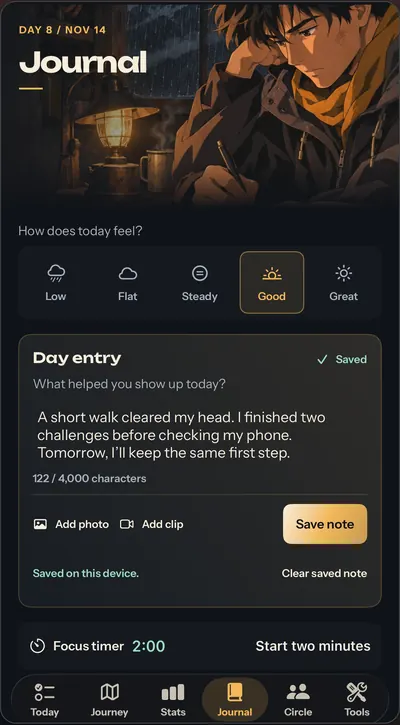
A detox works better when the freed-up time already has a job. If you like structure, Zenith: Level Up in 21 Days, available to pre-order on the App Store for iPhone (Apple expects Nov 20, 2026), gives you three weeks of daily real-life challenges. It also has a Focus timer, Quiet reset (guided breathing) and a journal with a mood check-in, all saved on your phone. It doesn't block apps, so set your fences with your phone's Screen Time. See how the weeks work on the 21-day plan page. If screens are only part of the problem, a full monk mode may suit you better.
Questions people ask
What will a dopamine detox do?
A sensible dopamine detox breaks the automatic loop of reaching for your phone or game whenever you're bored. You notice your triggers, get used to boredom and free up hours for training, study or people. It will not 'reset' your brain chemistry or cure anything. In a study where people quit Facebook for four weeks, well-being rose modestly and time with friends and family went up.
How long does a dopamine reset take?
There's no measured timeline, because a dopamine reset isn't a medical procedure. The original version suggested breaks of one to four hours each evening, plus a day a week. Stanford psychiatrist Anna Lembke has said a month is typically the minimum for stepping back from social media. A practical approach is a 7-day reset, then 21 days if it helps.
What does dopamine burnout feel like?
Dopamine burnout is not a medical term. People use it to describe feeling flat, restless and unable to focus after long stretches of scrolling or gaming, where normal tasks feel dull. Cutting back and sleeping well often helps. If low mood, low energy or loss of interest lasts for weeks, talk to a doctor, because those can be signs of something that needs proper care.
What are the symptoms of high dopamine levels?
Cleveland Clinic lists possible signs linked with high dopamine, such as trouble sleeping, poor impulse control and aggression, but these are tied to medical conditions, not to a scrolling habit. You can't measure your dopamine at home, and a detox isn't a treatment. If you're worried about your mood or behaviour, talk to a doctor rather than self-diagnosing.
What is a dopamine menu?
A dopamine menu is a list of enjoyable activities sorted like a restaurant menu: quick 'appetisers', longer 'mains', 'sides' you pair with boring tasks, and 'desserts' to enjoy in moderation. The idea was popularised in 2020 by the How to ADHD channel. You write it in advance, so when you're bored you pick from the menu instead of opening your phone.
Is a dopamine detox real?
The behaviour change is real; the name isn't. Dopamine is a chemical messenger your brain makes all the time, and you can't remove it. Psychologist Cameron Sepah, who coined 'dopamine fasting' in 2019, framed it as a behaviour-therapy method for problem habits. A Cleveland Clinic psychologist puts it bluntly: there's no such thing as a true dopamine detox.
What are dopamine detox side effects?
The common ones are boredom, cravings and irritability in the first few days, especially at the times you'd normally scroll. Boredom is usually the hardest part. They tend to ease once you have a plan for those moments. If you feel genuinely unwell, anxious or low for more than a few days, stop and talk to a doctor.
Sources
- Dopamine Detoxes Don't Work: Here's What To Do InsteadCleveland Clinic, 2024-09-09
- Silicon Valley takes on 'Dopamine Fasting 2.0' to battle bad habits, addictionABC7 News, 2019-11-09
- Dopamine fasting: Misunderstanding science spawns a maladaptive fadHarvard Health Publishing (Peter Grinspoon, MD), 2020-02-26
- Addictive potential of social media, explainedStanford Medicine, 2021-10-29
- Dopamine menus: the science behind the trend and how it might help people with ADHDThe Conversation, 2023-12-11
- DopamineCleveland Clinic, 2022
- The Welfare Effects of Social MediaAmerican Economic Review (Allcott, Braghieri, Eichmeyer and Gentzkow), 2020
- Holding the Hunger Games Hostage at the Gym: An Evaluation of Temptation BundlingManagement Science (Milkman, Minson and Volpp), 2014