How to stop procrastinating (and stop feeling lazy)
In short
To stop procrastinating, deal with the feeling, not just the schedule. Procrastination is mostly short-term mood repair: you dodge a task because it feels boring, hard or scary. Name the feeling, shrink the first step to two minutes, start a timer, remove your easy escape (usually the phone), and forgive yourself fast when you slip.
Key takeaways
- Research frames procrastination as short-term mood repair: you avoid the bad feeling now and hand the cost to your future self.
- The strongest predictors of procrastination include how unpleasant the task feels, low confidence, impulsiveness and distractibility.
- A two-minute first step plus a visible timer beats waiting until you feel ready, because feeling ready usually comes after starting.
- Students who forgave themselves for procrastinating before one exam procrastinated less before the next one.
- Internet-based CBT reduced procrastination in a randomized trial, so if it's chronic, structured help is worth trying.
In this guide14 sections
How to stop procrastinating: the short answer
If you want to know how to stop procrastinating, start here: you're not avoiding the task, you're avoiding a feeling. Boredom, confusion, the fear of doing it badly. So the fix isn't a better to-do list. It's making the first step so small that the feeling can't stop you.
Do this now: name the task, name the feeling, shrink the first step to two minutes, put your phone in another room and start a 10-minute timer. You're allowed to stop when it rings. Most days you won't.
Why do we procrastinate?
We procrastinate because avoiding a task makes us feel better right now. Researchers Fuschia Sirois and Tim Pychyl describe procrastination as short-term mood repair: the task triggers a bad feeling, putting it off brings quick relief, and your future self pays the bill.

Text version
| Step | What | Detail |
|---|---|---|
| Trigger | The task feels bad | Boring, hard, or you're scared of doing it badly. |
| Dodge | You put it off | Phone, tidying, 'I'll do it later'. |
| Reward | Quick relief | The bad feeling fades, right now. |
| Cost | Future you pays | Less time and more stress when the deadline hits. |
A large meta-analysis of 691 correlations by Piers Steel found the strongest predictors of procrastination were:
- Task aversiveness: how boring, hard or unpleasant the task feels.
- Distance to the deadline: far-off rewards feel weaker than right-now ones.
- Low self-efficacy: doubting you can do it well.
- Impulsiveness and distractibility: the phone wins because it's right there.
Notice "lazy" isn't on the list. Every item above is something you can change: make the task feel smaller, bring the deadline closer, build a quick win, and move the distraction.

See the numbers
| Value (r) | |
|---|---|
| Easily distracted | .45 |
| Impulsive | .41 |
| Task feels unpleasant | .40 |
| Low confidence (self-efficacy) | .38 |
| Thrill-seeking (weak link) | .17 |
The Name, Shrink, Start method
Use three moves every time you catch yourself stalling. It takes under five minutes.
- Name it. Say what you're avoiding and why: "I'm avoiding the essay because I don't know how to start the intro." Naming the feeling takes some of its power away.
- Shrink it. Cut the task until the first step takes two minutes. Not "write the essay." Write the essay's first ugly sentence. Not "clean the room." Pick up five things.
- Start it. Phone out of reach, timer on, do the two minutes. When the timer ends, decide whether to keep going. Starting is the hard part; continuing is usually easier.
12 tactics to stop procrastinating and get things done
These are the tactics that hold up best, grouped by the cause they fix.
When the task feels too big or vague
- Write the next physical action. "Open the spreadsheet and fill in column A," not "work on budget."
- Use a two-minute start. Commit only to starting. Momentum does the rest.
- Lower the bar for the first draft. Give yourself permission to do it badly first. You can't edit a blank page.
When distraction wins
- Put the phone in another room. Changing the situation beats resisting it, as research on situational self-control suggests.
- Close every tab you don't need. One window, one task.
- Work in timed blocks. 25 to 50 minutes on, 5 to 10 off. The timer turns a vague task into a short race.
When there's no deadline pressure
- Make an if-then plan. "If it's 4 p.m., then I open my notes at the desk." Plans that state when and where had a medium-to-large effect on reaching goals across 94 tests.
- Create a small outside deadline. Tell a friend or colleague you'll send a draft by Thursday.
- Do the dreaded task first. Before email, before scrolling, before the day gets loud.
When the feeling is the real problem
- Pair it with something you like. Music you only play while cleaning. A coffee you only get while studying.
- Forgive yourself quickly. In a study of 134 students, those who forgave themselves for procrastinating before one exam procrastinated less before the next (Wohl, Pychyl and Bennett, 2010). Guilt keeps you stuck.
- Reward the start, not just the finish. Tick a box when you start the session. Starting is the behaviour you're training.
Procrastination that looks like work
Some of the worst procrastination feels productive. You're busy, but the scary task hasn't moved. Watch for these:
- Planning forever. A new app, a new system, a colour-coded schedule, and zero hours on the actual task.
- Researching forever. One more video on how to study, one more article on the perfect workout split.
- Tidying first. The desk, the inbox, the files. It feels like getting ready. It's often avoidance.
- Doing easy tasks. Ten small emails instead of the one hard one.
The test is simple: at the end of the day, did the task you were avoiding move forward? If not, tomorrow's first block goes to that task before anything else.
Perfectionism and procrastination
Perfectionism is procrastination in a nicer shirt. If the work has to be great, starting feels risky, so you wait. The fix is to separate drafting from judging. First pass: get it done badly. Second pass: make it better. A finished B-grade draft beats a perfect plan that never leaves your head.
How to stop being lazy
To stop being lazy, find out what "lazy" actually is for you, because it's usually something else. Calling yourself lazy feels honest, but it gives you nothing to fix.
| What feels like laziness | What it often is | Try this |
|---|---|---|
| "I can't get off the couch" | Low energy from poor sleep or no movement | A 10-minute walk, then the task |
| "I don't know where to start" | An unclear task | Write the next physical action |
| "It's too much" | Overwhelm | Do one 15-minute block, then stop |
| "What's the point?" | No clear reason, or low mood | Link the task to one thing you care about |
| "I'll do it later" | Mood repair (procrastination) | Name, Shrink, Start |
If you're thinking "how to stop being lazy and unmotivated," start with the body: sleep, daylight, a walk, real food. Then pick one small task and finish it. One finished thing changes your mood more than an hour of planning. For the motivation side, read how to get motivated.
Why do students procrastinate?
Students procrastinate because homework often feels unpleasant, deadlines feel distant, and confidence can be low, which are exactly the strongest predictors in Steel's review. Add a phone on the desk and the odds get worse.
How to stop procrastinating on homework:
- Start homework at the same time daily, right after you get home and eat.
- Phone in another room, not face-down on the desk.
- Break each assignment into 25-minute blocks and write them down.
- Do the subject you dread first, while you're fresh.
- Study with a friend on a call if being alone makes it easy to drift.
How to avoid procrastination at work
At work, the trick is deciding your first task before the day decides for you. Before you log off, write tomorrow's first task. When you log on, do it before email or chat.
Block 60 to 90 minutes of focus time on your calendar, turn notifications off, and break big projects into steps under an hour. If a project has no deadline, make one: tell your manager or a colleague when you'll share a rough draft.
Can CBT help with procrastination?
Yes. Cognitive behavioural therapy has trial evidence for procrastination. In a randomized controlled trial of 150 people, internet-based CBT reduced procrastination compared with a wait-list, both with and without a therapist's guidance. About 31 to 40 percent in the guided group reached clinically significant change.

See the numbers
| Low | High | |
|---|---|---|
| Therapist-guided | 31.3% | 40% |
| Unguided self-help | 24% | 36% |
How can I treat chronic procrastination?
If procrastination keeps hurting your grades, job or health, treat it as a real problem, not a character flaw. Use the structure in this guide for three weeks. If it isn't enough, talk to a professional. Procrastination can sit alongside anxiety, low mood or ADHD, and a doctor can help work out what's going on.
How to stop procrastinating with ADHD
If you have ADHD, or think you might, the usual advice ("just start") often isn't enough, because attention and organisation are part of the challenge. What tends to help is outside structure: a visible timer, very short work blocks, the next step written down where you'll see it, and working alongside someone, even on a video call.
Make tasks more interesting where you can: change locations, race a timer, or pair boring work with music. Keep this guide as a set of tools, not a fix. If you think you have ADHD, talk to a doctor; they can assess it properly and discuss options.
Worked examples: student, 9-to-5, gym beginner
Here's the method applied to three common stalls.
| Student | 9-to-5 guy | Gym beginner | |
|---|---|---|---|
| Stall | History essay due Friday | Updating his CV for a new job | Keeps "starting next week" |
| Feeling | Doesn't know how to start | Feels awkward selling himself | Nervous about looking clueless |
| Two-minute start | Write a bad first sentence | Open the file and update one line | Put on gym clothes after work |
| Block | 25 minutes, phone in kitchen | 30 minutes after dinner, twice a week | 20-minute beginner session |
| Outside deadline | Show a friend the intro by Wednesday | Send it to a friend to read by Sunday | Book a time with a mate |
In each case the plan targets the feeling first. The student isn't short on time; he's stuck at the blank page, so the first step is a bad sentence. The 9-to-5 guy isn't lazy; selling himself feels awkward, so he edits one line at a time. The gym beginner isn't unfit for the plan; he's nervous, so the first win is just showing up in gym clothes.
A 21-day anti-procrastination plan
Run this as three one-week blocks. 21 days is a plan format, not a scientific deadline; the goal is to prove you can start on demand.
| Week | Focus | Daily action |
|---|---|---|
| Days 1–7: The first climb | Start on cue | One 25-minute block on your most-avoided task. Phone out of the room. |
| Days 8–14: Rhythm | Make starting automatic | Two blocks a day. Write the next step at the end of each one. |
| Days 15–21: Proof | Look back at the climb | Keep two blocks. Count how many you started on time and what you finished. |
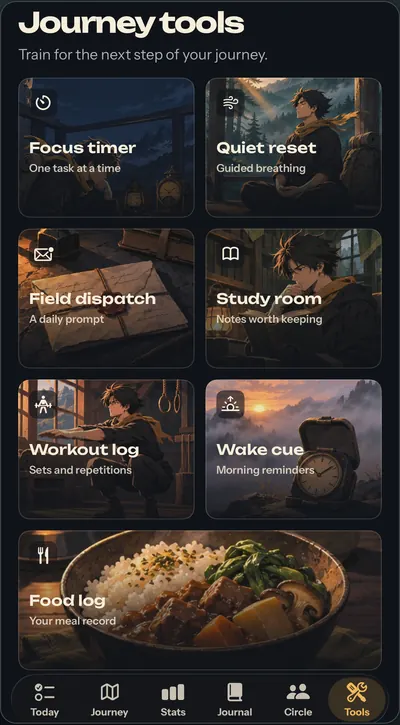
Use the 21-day plan to set it up. Zenith: Level Up in 21 Days, available to pre-order on the App Store (Apple expects Nov 20, 2026), includes a Focus timer built around one task at a time and Quiet reset for guided breathing, if you want those blocks on your phone. Timer and tool saves don't tick off a challenge for you, so you still mark the block done yourself.
If you miss a day
Missing a day isn't failure; it's data. Use these rules so one bad day stays one bad day:
If staying on track day after day is your weak spot, read how to stay consistent. For the bigger picture, see how to build self-discipline. And when you're ready, start the climb with Zenith and let the started blocks add up.
Questions people ask
How do I stop procrastinating right now?
Pick the task, name the feeling you're avoiding (bored, stuck, scared of doing it badly), then shrink the first step to something that takes two minutes, like opening the document and writing one ugly sentence. Put your phone in another room, start a 10-minute timer and give yourself permission to stop when it rings. Most of the time you'll keep going.
Why do I procrastinate even on things I care about?
Because caring raises the stakes. Researchers describe procrastination as short-term mood repair: the task triggers a bad feeling such as boredom, doubt or fear of failing, and avoiding it brings quick relief. The cost lands on your future self. That's why important tasks, like a big assignment or a job application, are often the ones you delay most.
How do I stop being lazy?
Treat 'lazy' as a clue, not a verdict. What feels like laziness is usually tiredness, an unclear task, overwhelm or low mood. Fix the real cause: sleep and move first, turn the task into one concrete next step, and set a tiny minimum. If low energy and low mood last for weeks, talk to a doctor or mental health professional.
Can CBT help with procrastination?
Yes, there's evidence it can. In a randomized controlled trial with 150 people, internet-based cognitive behavioural therapy, with or without a therapist's guidance, reduced procrastination more than a wait-list. About a third of people in the guided group showed clinically significant change. If procrastination is causing real distress, a CBT-trained professional is a reasonable next step.
Why do students procrastinate?
Students procrastinate mostly because schoolwork often feels unpleasant, deadlines feel far away, and confidence about doing it well can be low. Research on procrastination also points to impulsiveness and distraction, which a phone on the desk makes worse. Breaking homework into small, timed blocks and studying away from the phone tackles most of those causes at once.
How do I avoid procrastination at work?
Decide tomorrow's first task before you log off, and do it before email or chat. Break big projects into steps that take under an hour, block focus time on your calendar, and turn off notifications during it. Tell a colleague when you'll share a draft, because a small outside deadline helps. Review on Friday what you delayed and why.
How can I treat chronic procrastination?
Chronic procrastination that hurts your grades, job or health is worth taking seriously. Start with structure: daily planning, timed work blocks, fewer distractions and quick self-forgiveness after slips. If that isn't enough, talk to a professional. CBT has evidence for procrastination, and procrastination can sometimes sit alongside anxiety, low mood or ADHD, which a doctor can assess.
Sources
- Procrastination and the priority of short-term mood regulation: Consequences for future selfSocial and Personality Psychology Compass, 2013
- The nature of procrastination: A meta-analytic and theoretical review of quintessential self-regulatory failurePsychological Bulletin, 2007
- Internet-based cognitive-behavior therapy for procrastination: A randomized controlled trialJournal of Consulting and Clinical Psychology, 2015
- I forgive myself, now I can study: How self-forgiveness for procrastinating can reduce future procrastinationPersonality and Individual Differences, 2010
- To cure procrastination, forgive yourselfBPS Research Digest, 2010
- Implementation intentions and goal achievement: A meta-analysis of effects and processesAdvances in Experimental Social Psychology, 2006
- Situational strategies for self-controlPerspectives on Psychological Science, 2016
- Caring for your mental healthNational Institute of Mental Health, 2024