How to get motivated when you don't feel like it
In short
To get motivated, stop waiting for the feeling and start with a step so small it needs no motivation at all. Motivation often follows action: two minutes in, the task feels lighter. Make the goal clear, cut the first step down, remove easy distractions, pair the task with something you enjoy, and make your progress visible so you can see it adding up.
Key takeaways
- Motivation often follows action, so the best way to get motivated is a first step small enough to start without it.
- Self-determination theory links lasting motivation to three needs: choice, feeling capable and connection with others.
- Pairing a task with something you enjoy raised gym visits by 51 percent at first in one field study, though the effect faded over time.
- Fresh starts like a new week or month boost the urge to begin, so use them to start, then rely on a plan to continue.
- If low motivation comes with low mood for two weeks or more, it may be more than a motivation problem; talk to a professional.
In this guide17 sections
How to get motivated: start before you feel ready
The fastest way to learn how to get motivated is to stop waiting for motivation. It's a feeling, and feelings often show up after you start, not before. Two minutes into a workout or a study session, the task usually feels lighter than it did from the couch.
So the plan is simple: make the first step so small you don't need motivation to take it. Put on your running shoes. Open the notes. Fill one bin bag. Then let momentum do the rest.
What is the biggest motivation killer?
The biggest motivation killer is a goal that's too big or vague to start today. "Get in shape" or "sort my life out" gives you nothing to do at 6 p.m. on a Tuesday. Here are the usual suspects:
| Motivation killer | Why it drains you | Quick fix |
|---|---|---|
| Vague goal | No clear first step | Write the next physical action |
| Huge goal | The gap feels impossible | Set a 7-day goal you can finish |
| Poor sleep | Everything feels heavier | Fixed wake time, screens off earlier |
| Easier rewards in your pocket | The phone always wins against effort | Phone in another room for the first 20 minutes |
| No visible progress | Effort feels pointless | Track sessions on a calendar |
| Someone else's goal | You don't care enough | Pick one goal you'd choose for yourself |
What actually drives motivation
Research on self-determination theory by Richard Ryan and Edward Deci links lasting motivation to three needs:
- Autonomy: you chose it. A goal forced on you fades fast.
- Competence: you feel yourself getting better. Small wins feed this.
- Relatedness: you're connected to other people, like a training partner or study group.
Most motivation tricks work because they hit one of these. Visible progress feeds competence. A friend to train with feeds relatedness. Picking your own plan feeds autonomy.
The 4-step motivation reset
When you're stuck, run these four steps in order. It takes about ten minutes.
- Check your state. Tired, hungry, wired? Drink water, eat something, step outside for five minutes. Low energy feels like low motivation.
- Shrink the task. Cut it down until the first step takes two minutes.
- Start with a timer. Ten minutes, phone out of reach. Permission to stop when it rings.
- See the progress. Tick it off somewhere you'll see tomorrow. Seeing the chain grow becomes its own reason to continue.

Text version
| Step | What | Detail |
|---|---|---|
| Step 1 | Check your state | Water, food, five minutes outside. |
| Step 2 | Shrink the task | Cut it until the first step takes two minutes. |
| Step 3 | Start a timer | Ten minutes, phone out of reach. |
| Step 4 | See the progress | Tick it off where you'll see it tomorrow. |
Discipline vs motivation: which one do you need?
You need both, but discipline carries you when motivation doesn't show up. Motivation gets you to sign up for the gym in January. Discipline gets you there in the third week of February. Use bursts of motivation to set things up (pack the bag, write the plan, clear the desk) so that the discipline part is easier later. For the full system, read how to build self-discipline.
How to get motivated to work out
To get motivated to work out, make the session easy to start and something you look forward to.
- Pack the bag the night before and put it by the door.
- Use an if-then plan: "If I leave work, then I drive straight to the gym." Plans like this had a medium-to-large effect on reaching goals across 94 tests.
- Bundle it with something you love. In a field study, people who could only hear their favourite audiobooks at the gym went 51 percent more often at first. The effect faded over time, so treat it as a starter, not the whole plan.
- Keep it short and simple at first. In a study of new gym members, consistency, simple workouts and enjoyment all predicted building an exercise habit.
- For a run: decide the route the night before and commit only to the first five minutes.

See the numbers
| Value (%) | |
|---|---|
| Audiobooks only at the gym | +51% |
| Encouraged to save them for the gym | +29% |
How to get motivated to study
Studying feels bad mostly at the start. Lower that start.
- Pick one subject and one task: "15 flashcards on chapter 4," not "revise biology."
- Phone in another room, desk cleared.
- Study for 25 minutes, break for 5.
- Study with a friend on a call if being alone makes it easy to drift.
- Keep a page of finished sessions. Seeing it fill up keeps you going on the bad days.
If you keep delaying the hardest subjects, read how to stop procrastinating.
How to get motivated for work
At work, motivation dips when every day looks the same and nothing feels finished. Pick one task each morning that you'll fully complete, and do it before email. Break big projects into steps you can finish in an hour. Keep a short "done" list each day; on bad weeks, it reminds you that you're still moving.
How to get motivated to clean
Cleaning feels endless, so give it an end. Set a 10-minute timer and clean one zone: the desk, the sink, the floor of your room. Put on music or a podcast you save for cleaning. Stop when the timer rings if you want to. Usually, seeing one clean area makes you want to do the next.
How to get motivated to lose weight
Track behaviours, not just the scale. The scale moves slowly and jumps around, which kills motivation. Behaviours like "walked 30 minutes" or "cooked dinner at home" can be ticked off every day. Set a weekly behaviour goal, review it on Sunday, and talk to a doctor before big changes to your diet or training.
How to get motivated when depressed
Depression can drain motivation and energy, and pushing harder doesn't always work. Go tiny and be kind to yourself: open the curtains, drink a glass of water, walk for five minutes, message one person, or do one small chore. Small actions can help a little, but they're not treatment.
Is there a pill that gives you motivation?
No pill creates motivation for your goals. Drive comes from a clear goal, small wins, enough sleep and people around you. Don't chase energy or focus with anything you haven't discussed with a doctor. If low motivation won't go away, that's worth a proper check-up, not a shortcut.
What are the 5 P's of motivation?
There's no single official list; workplace versions often use purpose, pride, praise and pay. For personal goals, try this five:
- Purpose: why this matters to you.
- Plan: when and where you'll do it.
- Progress: a way to see it adding up.
- People: someone who knows your goal.
- Pause: rest, so you don't burn out.
Worked examples: student, 9-to-5, gym beginner
Here's the 4-step reset applied to three real slumps.
| Student | 9-to-5 guy | Gym beginner | |
|---|---|---|---|
| The slump | Can't face revision after school | Too drained after work to touch his side project | Signed up three weeks ago, been twice |
| Check your state | Eats a snack and drinks water first | Takes a 10-minute walk after getting home | Sleeps 30 minutes earlier on gym nights |
| Shrink the task | 15 flashcards, one chapter | Write one paragraph or fix one bug | 20-minute session, three exercises |
| Start with a timer | 25 minutes, phone in the kitchen | 20 minutes at the desk before dinner | Timer on as he walks in the door |
| See the progress | Ticks a box on a wall calendar | Keeps a running list of what he shipped | Logs every session, even short ones |
None of them waited to feel like it. Each one made the start smaller and the progress more visible, and the motivation followed.
How to get motivated to do anything
The same rule works for any task: lower the start, raise the visibility. Ask two questions. What's the smallest version of this I could do in two minutes? And where will I see that I did it? If you can answer both, you can start almost anything, even on a flat day. If you can't, the task is still too big or too vague. Cut it again.
A 21-day motivation plan
Use three weeks as a block you can finish. 21 days is a plan format, not a promise that motivation will be permanent. Fresh starts like a new week or month make people more likely to start goals, so begin on a Monday or the 1st if it helps.

See the numbers
| Value (%) | |
|---|---|
| Start of a semester | +47.1% |
| Start of a week | +33.4% |
| After a school break | +24.3% |
| Start of a month | +14.4% |
| Start of a year | +11.6% |
| After a birthday (not the 21st) | +7.5% |
| Week | Focus | Daily |
|---|---|---|
| Days 1–7: The first climb | Start small | One two-minute start on your main goal. Tick it off. |
| Days 8–14: Rhythm | Build momentum | Grow it to 15–20 minutes. Add an enjoyable pairing. |
| Days 15–21: Proof | See it add up | Keep going. On Day 21, count your ticks. |
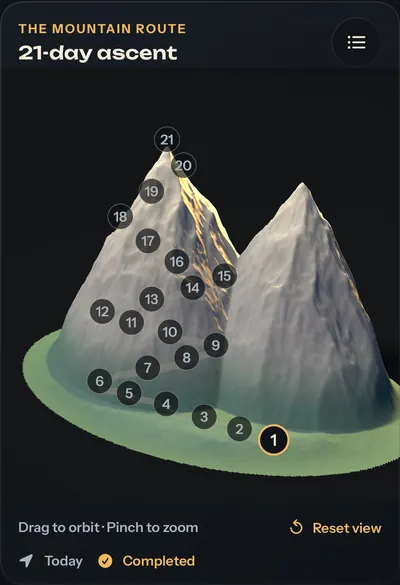
The 21-day plan generator can lay out the three weeks for you. If you want to watch progress grow, Zenith: Level Up in 21 Days turns each day into challenges with XP and streaks. Your character evolves from E Initiate toward S Ascendant as the XP adds up, and a 3D mountain shows the climb from Day 1 at the base to Day 21 at the summit. It's available to pre-order on the App Store, and Apple expects Nov 20, 2026.
If you miss a day
A missed day doesn't mean your motivation is gone. Do the two-minute version the next day, don't try to make up for it with a double session, and never miss twice in a row. For more on keeping going, read how to stay consistent.
Motivation comes and goes. A small start, repeated, is what lasts, and Zenith is there if you want to see the climb.
Questions people ask
How do I get motivated myself?
Start before you feel ready. Pick one clear task, shrink the first step until it takes two minutes, put your phone out of reach and begin. Motivation often builds once you're moving. Then make progress visible with a tick on a calendar or a log, because seeing yourself improve is one of the most reliable sources of motivation there is.
What is the biggest motivation killer?
The biggest motivation killer is a goal that's too big or too vague to start. 'Get in shape' gives your brain nothing to do today. Close behind are poor sleep, a phone full of easier rewards, no visible progress and goals you don't really own. Fix the first one by writing the next physical action, like 'put on running shoes at 6 p.m.'
Is there a pill that gives you motivation?
No pill creates motivation for your goals. Feeling driven comes from clear goals, small wins, rest and people around you. Don't self-medicate with anything to chase energy or focus. If you have constant low motivation, low energy or low mood, talk to a doctor, because it can be a sign of a health issue that deserves proper attention.
What are the 5 P's of motivation?
There's no single official list; versions online range from workplace lists (purpose, pride, praise, pay) to coaching ones. For personal motivation, a practical five is purpose (why it matters), plan (when and where), progress (seeing it add up), people (someone who knows your goal) and pause (rest so you don't burn out). Weak motivation usually means one of these is missing.
How do I get motivated to work out?
Make the workout easy to start and enjoyable to repeat. Pack your bag the night before, set an if-then plan ('if I leave work, I drive to the gym'), and keep sessions short at first. Save a podcast or audiobook you love for the gym only. Track sessions, not weight, so you can see progress from the first week.
How do I get motivated when I'm depressed?
Depression can drain motivation, so be gentle and go tiny: get up and open the curtains, drink water, take a five-minute walk, message one person. Small actions can help a little, but they don't replace care. If low mood, loss of interest or exhaustion last two weeks or more, talk to a doctor or mental health professional. If you are struggling, call or text 988 in the U.S. or Canada, Samaritans on 116 123 in the U.K., Lifeline on 13 11 14 in Australia, or Tele-MANAS on 14416 in India.
Sources
- Self-determination theory and the facilitation of intrinsic motivation, social development, and well-beingAmerican Psychologist, 2000
- Holding the Hunger Games hostage at the gym: An evaluation of temptation bundlingManagement Science, 2014
- The fresh start effect: Temporal landmarks motivate aspirational behaviorManagement Science, 2014
- Implementation intentions and goal achievement: A meta-analysis of effects and processesAdvances in Experimental Social Psychology, 2006
- Exercise habit formation in new gym members: A longitudinal studyJournal of Behavioral Medicine, 2015
- DepressionNational Institute of Mental Health, 2024
- Caring for your mental healthNational Institute of Mental Health, 2024