Mental toughness: what it is and how to build it
In short
Mental toughness is the ability to stay steady, committed and confident when things get hard. The most-used model, the 4Cs, breaks it into control, commitment, challenge and confidence. You build it by choosing small, planned discomfort every day, keeping promises under mild pressure and reviewing how you handled it, not by ignoring pain or bottling up stress.
Key takeaways
- The 4Cs model describes mental toughness as control, commitment, challenge and confidence, building on earlier research on hardiness.
- Mental toughness is linked to better coping and outcomes in school and well-being, and it moves week to week, so it can be practised.
- Grit and resilience overlap with mental toughness but are not the same; grit is about long-term effort and resilience is about recovering from adversity.
- The simplest training is one small, chosen hard thing a day, made a little harder each week.
- Mental toughness is not hiding stress; if low mood or anxiety lasts, talking to a professional is the tough move.
In this guide14 sections
What is mental toughness?
Mental toughness is the ability to stay steady, committed and confident when things get hard. It's not about being loud, never feeling fear, or pushing through injuries. It's doing the thing you said you'd do while part of you wants to quit, and staying calm enough to think while you do it.
A useful mental toughness definition for daily life: you keep your promises under pressure, and you recover fast when you don't. Common synonyms include grit, resilience, composure and fortitude, but each means something slightly different (more on that below).
What mental toughness is not
A lot of what gets sold as mental toughness online is just noise. Mental toughness is not:
- Ignoring pain or injury. Pain is information. Smart athletes listen to it.
- Never feeling fear or doubt. Tough people feel both. They act anyway, with a plan.
- Bottling things up. Pushing feelings down tends to come back as anger, burnout or a crash.
- Being harsh to others. Toughness is about your own standards, not how loudly you push people.
- Extreme challenges for the camera. One ice bath on video teaches less than 30 days of keeping a small promise.
The 4Cs model of mental toughness
The most widely used model is the 4Cs, developed by Peter Clough and colleagues in 2002 from earlier research on hardiness. A 2017 systematic review describes the four parts like this:
| C | What it means | What it looks like on a normal day | A small daily drill |
|---|---|---|---|
| Control | You feel you can influence your life and keep anxiety in check | You focus on what you can change, not on what you can't | Write the one thing you control today, then do it first |
| Commitment | You stay involved in your goals when it gets difficult | You train on the cold, tired, rainy days | Keep one non-negotiable minimum each day |
| Challenge | You see threats as chances to grow | You take the hard set, the hard question, the hard conversation | Pick one small thing that scares you and do it |
| Confidence | You believe in your abilities and hold your ground with others | You speak up in class or a meeting | Keep a "done list" of hard things you've finished |
The same review found mental toughness was linked to better coping, more positive traits and better outcomes in education and mental health. That's correlation, not proof that toughness causes those outcomes, but it's a solid reason to train it.
Mental toughness vs grit vs resilience
These three get mixed up all the time. Here's the short difference.
| What it is | Best known from | |
|---|---|---|
| Mental toughness | Traits that help you perform under everyday pressure: control, commitment, challenge, confidence | Clough and colleagues' 4Cs model |
| Grit | Perseverance and passion for long-term goals | Duckworth and colleagues, 2007 |
| Resilience | Adapting well after significant adversity, often helped by support from others | Developmental psychology |
One honest caveat: a meta-analysis of 88 samples and 66,807 people found grit was only moderately linked to performance and very strongly overlapped with conscientiousness. The perseverance part mattered most. In other words, the useful bit is boring: keep showing up.
Can you train mental toughness?
Yes, partly. The 2017 review reports that about half of the variation in mental toughness is linked to genes, so the other half is shaped by what you do and what happens to you. It also describes a study that measured toughness weekly for ten weeks: a large share of the variation happened within the same person from week to week.

See the numbers
| Value (%) | |
|---|---|
| Within a person | 56% |
| Between people | 44% |
That's good news. Your toughness isn't fixed. It moves with your sleep, stress, training and habits, which means you can push it in the right direction.
How to build mental toughness: one small hard thing a day
The simplest training method is choosing one small, planned discomfort every day and keeping it. Call it your daily hard thing. You're teaching yourself that discomfort is survivable and that your word to yourself holds.
- Choose it the night before. Planned discomfort builds trust. Random suffering doesn't.
- Keep it small. Two minutes of a cold shower finish, a 10-minute run in the rain, one honest question in class.
- Make it an if-then. "If I finish brushing my teeth, then I do 20 push-ups." Plans that state when and where work better than good intentions.
- Notice the urge to quit, then do one more. One more rep, one more minute, one more paragraph.
- Write one line after. What was hard? What did you tell yourself? This trains the "control" and "confidence" Cs.
The discomfort ladder
Climb one rung a week. Don't jump to the top; that's how people get hurt or quit.
| Area | Rung 1 | Rung 2 | Rung 3 |
|---|---|---|---|
| Body | 10-minute walk in bad weather | 20-minute run | Hard interval session |
| Focus | 15 minutes, phone in another room | 30 minutes deep work | 60 minutes, one task |
| Social | Ask one question in class or a meeting | Give your honest opinion once | Have the conversation you've been avoiding |
| Comfort | No phone for the first 20 minutes awake | No phone in bed | One evening a week fully offline |
For a stricter version of this, see monk mode.
Tough or just stubborn? How to tell
Mental toughness and stubbornness can look the same from the outside. The difference is whether you're still thinking.
| Mentally tough | Just stubborn |
|---|---|
| Sticks to the goal, changes the plan when it isn't working | Sticks to the plan even when it clearly isn't working |
| Rests when the body needs it, then comes back | Trains through injury to prove a point |
| Asks for feedback and uses it | Hears feedback as an attack |
| Admits a bad day and resets fast | Pretends nothing went wrong |
| Asks for help when stress is too much | Thinks needing help means weakness |
How to stay mentally tough in the moment
When pressure hits right now (a penalty kick, an exam question you don't know, a tense meeting), use a 60-second reset.

Text version
| Step | What | Detail |
|---|---|---|
| 1 | Breathe out slowly | Two or three long exhales. |
| 2 | Name it | 'This is nerves.' |
| 3 | Next controllable action | The next play, question or sentence. |
| 4 | Say your cue word | 'Next' or 'calm', then go. |
- Breathe out slowly. A long exhale, two or three times. It gives your head a second to catch up.
- Name it. "This is nerves." Labelling the feeling makes it easier to work with.
- Find the next controllable action. Not the whole game or the whole exam. Just the next play, the next question, the next sentence.
- Use a cue word. One word you've practised with, like "next" or "calm," that pulls you back to the task.
Practise this in low-stakes moments first, so it's ready when the stakes are high.
Examples of mental toughness in everyday life
Mental toughness rarely looks dramatic. Here's what it looks like for three different guys.
- Student: He bombs a mock exam. Instead of hiding the result, he reads every wrong answer, writes down three topics to fix and studies them first this week. That's control and challenge.
- 9-to-5 guy: His manager rips apart his report in a meeting. He stays calm, asks two clear questions, fixes it by Friday and keeps his evening gym session anyway. That's control and commitment.
- Gym beginner: He feels everyone's watching him in the free-weights area. He goes anyway, three times a week, and starts with the bar. By week four it's just the gym. That's challenge and confidence.
Mental toughness for young athletes
For young athletes, mental toughness is mostly routines they can control. It isn't screaming coaches or playing through injury.
- Process goals: "Win the game" isn't controllable. "Sprint back on defence every time" is.
- A short pre-game routine: same warm-up, same three breaths, same cue word.
- A reset after mistakes: a physical cue (wipe the hands, touch the laces) that means "next play."
- Practice under mild pressure: timed drills, game-like scenarios, consequences that are small and fair.
- Honest review: one thing that went well, one thing to fix, no name-calling.
Here's what that looks like for a 15-year-old footballer who drops his head after every missed pass. His coach gives him one process goal (first two steps back toward the ball after any mistake) and one reset cue (clap twice, say "next"). After each game, he writes one good moment and one fix. Within a few weeks, the missed passes still happen, but the sulking doesn't.
Parents and coaches can help most by praising effort and choices, not just results, and by treating pain, injury or real distress as a reason to stop, not a test.
A 21-day mental toughness training plan
Here's a simple mental toughness program in three weekly blocks. 21 days is a plan format, not a scientific timeline: it's long enough to feel the change and short enough to finish.

Text version
| Day | Plan | Type |
|---|---|---|
| Day 1 | Walk in bad weather | Rung 1 |
| Day 2 | 15 min, phone away | Rung 1 |
| Day 3 | Ask one question | Rung 1 |
| Day 4 | No phone first 20 min | Rung 1 |
| Day 5 | Walk in bad weather | Rung 1 |
| Day 6 | 15 min, phone away | Rung 1 |
| Day 7 | Ask one question | Rung 1 |
| Day 8 | 20-minute run | Rung 2 |
| Day 9 | 15 min, phone away | Rung 1 |
| Day 10 | 20-minute run | Rung 2 |
| Day 11 | Ask one question | Rung 1 |
| Day 12 | 20-minute run | Rung 2 |
| Day 13 | No phone first 20 min | Rung 1 |
| Day 14 | 20-minute run | Rung 2 |
| Day 15 | 20-minute run | Rung 2 |
| Day 16 | 15 min, phone away | Rung 1 |
| Day 17 | 20-minute run | Rung 2 |
| Day 18 | Hard interval session | Rung 3 |
| Day 19 | Ask one question | Rung 1 |
| Day 20 | 20-minute run | Rung 2 |
| Day 21 | Read your log back | Rung 1 |
| Week | Focus | Daily |
|---|---|---|
| Days 1–7: The first climb | Commitment | One small hard thing a day, chosen the night before. Rung 1 only. |
| Days 8–14: Rhythm | Control and challenge | Move one area up to rung 2. Write one line after each hard thing. |
| Days 15–21: Proof | Confidence | Keep rung 2, try rung 3 once. On Day 21, read your log back. |
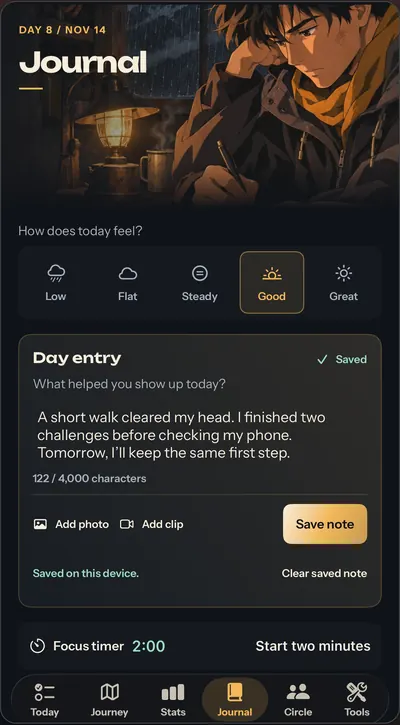
The 21-day plan shows how to structure the three weeks. If you'd like the daily hard things as challenges with XP, Zenith: Level Up in 21 Days lets you edit the weeks still ahead of you, so the plan can get harder as you do, while today and past records stay protected. Your character evolves from E Initiate toward S Ascendant as you earn XP. It's available to pre-order on the App Store, and Apple expects Nov 20, 2026.
If you miss a day
Toughness isn't a perfect record; it's how fast you come back. Use these rules:
For more on keeping a streak alive without burning out, read how to stay consistent.
Is mental toughness the same as good mental health?
No. Mental toughness can support well-being, but it isn't the same thing, and it never means hiding how you feel. Stress that builds without rest can hit your sleep, mood, focus and energy.
How to take care of your mental health, based on NIMH guidance: get regular exercise, eat regular meals, make sleep a priority, try a relaxing activity, set priorities and stay connected with people. NIMH also suggests seeking professional help if severe or distressing symptoms last two weeks or more.
Mental toughness books worth reading
If you want to go deeper, these are widely read starting points:
- Developing Mental Toughness (Peter Clough and Doug Strycharczyk): the 4Cs model, from its authors.
- Grit (Angela Duckworth): long-term effort and deliberate practice.
- Mind Gym (Gary Mack): short chapters on the mental side of sport.
Pick one idea from whichever you read and turn it into tomorrow's hard thing. Then build the rest of your routine with self-discipline, and use Zenith if you want to see the climb add up.
Questions people ask
What is mental toughness?
Mental toughness is the ability to stay steady, committed and confident under pressure. In sport psychology, the most-used model splits it into four parts: control over your emotions and life, commitment to goals despite setbacks, seeing challenges as chances to grow, and confidence in your abilities. In daily life, it looks like doing what you said you'd do on the days it's hard.
What are the 4 Cs of mental toughness?
The 4Cs are control, commitment, challenge and confidence. Control means feeling you can influence your life and keep anxiety in check. Commitment means sticking with goals despite difficulty. Challenge means seeing threats as chances to develop. Confidence means believing in your abilities and holding your ground with others. The model comes from Peter Clough and colleagues, building on hardiness research.
Can mental toughness be trained?
Partly, yes. Behavioural genetics research suggests about half of the differences in mental toughness are linked to genes, which means the other half is shaped by experience. One study measured it weekly and found a large share of the variation happened within the same person over time. Practising goal-setting, planned discomfort and reflection is a reasonable way to strengthen it.
How do young athletes build mental toughness?
Young athletes build mental toughness through routines they control: process goals for each session, a short pre-game routine, a reset cue after mistakes, and honest reviews with a coach. Training under mild, planned pressure helps too, like timed drills or game-like scenarios. Adults should praise effort and choices, not just results, and never push through injury or real distress.
What's the difference between mental toughness and resilience?
Resilience is usually described as adapting well after significant adversity, and it includes outside factors like support from others. Mental toughness is measured as a set of personal traits, including confidence and commitment, that help you perform under everyday pressure, not only after a crisis. They overlap and support each other, but a person can be strong in one area and still building the other.
How does stress affect mental health?
Short bursts of stress can sharpen focus, but stress that builds up without rest can affect sleep, mood, concentration and energy. The National Institute of Mental Health suggests regular exercise, sleep, relaxing activities and staying connected as self-care. If severe or distressing symptoms last two weeks or more, it recommends seeking professional help. Toughness includes knowing when to ask.
Sources
- Mental toughness and individual differences in learning, educational and work performance, psychological well-being, and personality: A systematic reviewFrontiers in Psychology, 2017
- Grit: Perseverance and passion for long-term goalsJournal of Personality and Social Psychology, 2007
- Much ado about grit: A meta-analytic synthesis of the grit literatureJournal of Personality and Social Psychology, 2017
- Caring for your mental healthNational Institute of Mental Health, 2024
- Implementation intentions and goal achievement: A meta-analysis of effects and processesAdvances in Experimental Social Psychology, 2006