How to get your life together (and start over) step by step
In short
To get your life together, start smaller than you think. Spend the first 72 hours on basics: sleep, a clean room, food, and writing down everything that is hanging over you. Then face your money and messages, pick three goals, and run a 21-day reset with one small daily action per goal. Order matters more than intensity.
Key takeaways
- Getting your life together starts with stabilizing basics like sleep, food and your room before setting big goals.
- Writing down every open task and making a specific plan for each one reduces the mental noise of unfinished goals.
- Pick no more than three goals and turn each into a small daily action written as an if-then plan.
- Starting over with no money means protecting your basics first, then building income, skills and savings in that order.
- If you have lost interest in almost everything for two weeks or more, a reset routine is not enough on its own; talk to a doctor.
In this guide9 sections
How to get your life together: start smaller than you think
The fastest way to get your life together is to fix the basics first and the big goals second. That is the core of how to get your life together, whether you are 17 and behind on school or 32 and starting over after a job or a breakup.
Most resets fail because they start with the dream: a new body, a new career, a new man by Friday. The dream needs a base. Sleep, food, a clean space and knowing what you owe come first. Then goals. Then speed.
Here is the order this page follows:
- The first 72 hours: stabilize and get everything out of your head.
- The checklist: the basics, printable.
- The 21-day reset: three goals, small daily actions, weekly reviews.
- Starting over: with no money, at 30 or later, after a setback.
Signs you need a reset (and when it's more than a reset)
You probably need a reset if several of these are true: your sleep has no pattern, your room is a mess you have stopped seeing, you avoid checking your bank balance or messages, you keep saying "next Monday", and most days feel the same.
That is normal and fixable. But one thing needs to be said clearly. If you have felt sad, empty or lost interest in almost everything, most of the day, nearly every day for two weeks or more, the NIMH lists that as a possible sign of depression. A routine will not fix that on its own. Talk to a doctor. If you are struggling or having thoughts of suicide, the NIMH points to the 988 Suicide and Crisis Lifeline: call or text 988 in the U.S. (988 also works in Canada). In the U.K., call Samaritans on 116 123; in Australia, Lifeline on 13 11 14; in India, Tele-MANAS on 14416. In an emergency, call your local emergency number.
The first 72 hours
The first three days are not about progress. They are about stopping the slide and seeing the whole picture.

Text version
| Step | What | Detail |
|---|---|---|
| Hours 0–24 | Stop the bleeding | One wake-up time. Clean one room. Eat a real meal. Write down everything hanging over you. |
| Hours 24–48 | Face the numbers | Money, messages and every deadline for the next three weeks. Give each brain-dump item a next action and a time. |
| Hours 48–72 | Pick your three | Score body, mind, money, people and purpose. Pick three goals and write one if-then plan for each. |
Hours 0–24: Stop the bleeding
- Set one wake-up time for tomorrow and the next two days, and keep it. The Sleep Foundation puts a consistent schedule at the top of its advice. For a full plan, see how to fix your sleep schedule.
- Clean one room. Trash out, dishes done, clothes in one pile. One hour, timer on. You do not need it perfect, just reset.
- Eat real food and drink water. Not a whole diet. Just a proper meal today.
- Do the brain dump. Write down every single thing hanging over you: tasks, bills, messages, deadlines, the gym, the call you have been avoiding. All of it, on paper.
Why the brain dump matters: unfinished goals keep popping into your head. A 2011 study by Masicampo and Baumeister found that making a specific plan for an unfinished goal reduced those intrusive thoughts, even before the goal was done. Writing it down is the first step. Planning it is the second.
Hours 24–48: Face the numbers
- Money. Open every account. Write down what you have, what you owe and what is due this month. Do not fix it yet. Just know it.
- Messages and mail. Reply to anything urgent. Archive the rest. Unsubscribe from what you do not read.
- Calendar. Write every deadline, exam, shift and appointment for the next three weeks in one place.
- Next to each brain-dump item, write one next action and when you will do it. "Call landlord Tuesday 5 p.m." beats "sort out rent".
Hours 48–72: Pick your three
- Score five areas from 1 to 5: body, mind, money, people, purpose. (The best version of yourself guide explains each.)
- Pick three goals: your two lowest scores plus the one you care about most.
- Turn each into a daily or weekly action, written as an if-then plan: "When I get home from class, I change and walk for 20 minutes." A meta-analysis by Gollwitzer and Sheeran found that if-then plans like this help people follow through on their goals.
- Clear one quick win. Do the smallest item on your brain-dump list right now. Momentum is real.
The get-your-life-together checklist
Print this or copy it into your notes. You do not need every box ticked to start the 21 days. You need most of the first two sections.
Room and basics
Body
Money and admin
People
Mind and direction
The 21-day reset
Once the basics are steady, run a three-week reset. It is short enough to finish and long enough to feel a change. It is not long enough to make habits permanent: a habit study by Lally and colleagues found a median of 66 days for habits to become automatic. Think of 21 days as the first climb.

See the numbers
| Low | High | Marked | |
|---|---|---|---|
| Habit felt automatic (study) | 18 | 254 | median 66 |
| This 21-day reset | 1 | 21 |
| Week | Theme | Daily | Weekly |
|---|---|---|---|
| Week 1 | Prove you can start | Same wake time. One small action for each of your three goals (10–20 minutes each). | Sunday: 10-minute review. What worked? What was too big? |
| Week 2 | Make it yours | Keep the actions. Move any that keep slipping to a better time of day. | Money check. One plan with a friend. Clean room reset. |
| Week 3 | Look back | Make one action slightly bigger. Keep the others the same. | Day 21: rescore the five areas and compare with day 1. |
Rules for the reset:
- Never miss twice. Miss a day, fine. Miss two in a row and you are rebuilding the old pattern.
- Track it on paper. The habit tracker template gives you a printable 21-day grid.
- Procrastinating on one goal? It is probably too big. Cut it in half. The guide on how to stop procrastinating has more on this.
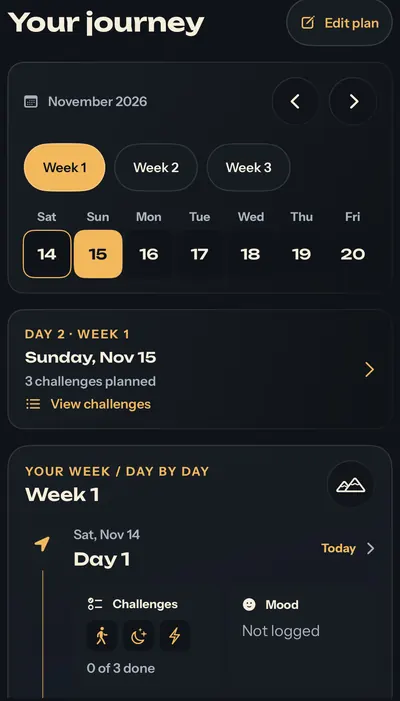
Zenith: Level Up in 21 Days is built around this same three-week shape: a free assessment, then a 21-day plan of small daily challenges that you do in real life and mark done yourself. You can edit the weeks ahead as life changes, while today and past records stay protected. It's available to pre-order on the App Store, and Apple expects Nov 20, 2026.
How to start over in life
Starting over means rebuilding from a lower point than you would like, on purpose. The order is the same as above: basics, then direction, then speed. A few situations need extra notes.
How to start over with no money
- Protect the basics first: a safe place to sleep, food, a phone and transport. Everything else waits.
- Get income before the perfect job. Any honest work buys time and structure while you look for better.
- Cut costs you do not see: subscriptions, delivery apps, small daily spends. Write every purchase for one week.
- Start a tiny emergency fund. The Consumer Financial Protection Bureau notes that even small savings give some security, and suggests automatic transfers so you do not have to think about it.
- Use free skill-building. Libraries, free online courses and community programs cost nothing but time.
How to start over at 30, 40 or later
You are not behind. You have more experience, more self-knowledge and usually more skills than you did at 20. Use them. Pick one direction for the next 90 days instead of trying to rebuild everything at once. Talk to people a few years ahead of you on the path you want. Most are happy to give 20 minutes of advice if you ask politely and specifically.
After a breakup, job loss or failure
Give yourself a few days to feel it. Then go back to the 72-hour plan. Keep your routine boring and steady: sleep, movement, food, people. Avoid big decisions in the first couple of weeks if you can. Lean on friends. This is exactly what the people pillar is for.
How to get your mental together
Getting your head straight usually follows getting your days straight. You cannot think your way out of a chaotic routine, but a steady routine makes thinking easier.
The behavioral basics that help most people feel more settled:
- Same wake-up time every day. It anchors everything else.
- Move daily. A walk counts. So does a short workout in your room.
- Daylight. Get outside in the morning, even for a few minutes.
- Less late-night scrolling. The hour before bed is when most spiraling happens.
- Write it down. Worries on paper are easier to plan for than worries in your head.
- Talk to someone. A friend, a family member, a coach, a counselor. Saying it out loud shrinks it.
If your mind still feels heavy after a few weeks of steady basics, that is useful information, not failure. It is a reason to talk to a doctor or counselor, which is a sign of taking yourself seriously.
What to stop doing while you reset
Getting your life together is partly about what you add and partly about what you stop. These are the habits that quietly undo most resets:
- Planning instead of doing. A perfect Notion setup is not progress. If planning takes longer than an hour, start with what you have.
- Announcing it everywhere. Telling the internet you are changing can feel like you already did it. Tell one person you trust instead.
- Staying up "for yourself". Late nights feel like freedom after a long day. They cost you the next morning, every time.
- Spending to feel better. New gear, supplements, courses. None of it does the reps for you.
- Measuring yourself against people who are years ahead. Compare day 21 with day 1. Nothing else.
- Waiting for the right Monday. The best day to start the 72 hours is the next one you have free.
Make room for something good
A reset is not only cleaning up. Add one thing you look forward to each week, or the plan starts to feel like a punishment. Something small, new and cheap works best, like the ideas in our list of real-life side quests.
Getting your life together is not one big moment. It is a clean room, a kept wake-up time and a bill paid on time, repeated until it feels normal.
Questions people ask
How do I get my life together?
Start with the basics for three days: a fixed wake-up time, a clean room, real meals and a written list of everything hanging over you. Then check your money and messages, pick three goals, and turn each into one small daily action. Run that for 21 days, review weekly, and add more only when the first actions feel normal. Small and steady beats a dramatic Monday.
How do I start over in life?
Accept where you are, without blaming yourself or anyone else, and stabilize the basics first: sleep, food, a safe place to live and enough money for this month. Then choose one direction to rebuild, such as a job, a skill or your health, and take one daily action toward it. Starting over is less about a big decision and more about the next three weeks.
How to get your mental together?
Use the basics that support mood and focus: a regular sleep schedule, daily movement, daylight, real meals, less late-night scrolling, and time with people you trust. Write down what is on your mind and make a plan for each item. This is not medical advice. If low mood, anxiety or numbness lasts for weeks, talk to a doctor or counselor.
What are the top 3 goals in life?
There is no universal top three, but most people's lists land on health, relationships and meaningful work or money. A practical way to pick yours: score body, mind, money, people and purpose from 1 to 5, then choose the two lowest plus the one you care about most. Three goals is enough. More than that and none get real attention.
Why have I lost the joy of life?
Sometimes it comes from burnout, poor sleep, isolation or a routine with nothing to look forward to. But losing interest or pleasure in most things, most of the day, nearly every day for at least two weeks can be a sign of depression, according to the NIMH. That needs a doctor, not just a new routine. If you are struggling or thinking about suicide, call or text 988 in the U.S. or Canada, Samaritans on 116 123 in the U.K., Lifeline on 13 11 14 in Australia, or Tele-MANAS on 14416 in India.
What are 7 things that can change my life?
Seven small changes with big knock-on effects: a fixed wake-up time, 20 minutes of movement a day, a clean room, a weekly money check, one real conversation with a friend each week, 30 minutes on a skill or project daily, and your phone out of the bedroom. None is dramatic. Together, done for a few weeks, they change how your days feel.
Sources
- Depression (NIH Publication No. 24-MH-8079)National Institute of Mental Health, 2024
- DepressionNational Institute of Mental Health, 2024-12
- Consider it done! Plan making can eliminate the cognitive effects of unfulfilled goalsJournal of Personality and Social Psychology (Masicampo & Baumeister), 2011
- Implementation Intentions and Goal Achievement: A Meta-analysis of Effects and ProcessesAdvances in Experimental Social Psychology (Gollwitzer & Sheeran), 2006
- An essential guide to building an emergency fundConsumer Financial Protection Bureau, 2025-10-29
- How to Fix Your Sleep ScheduleSleep Foundation, 2025-07-24
- How are habits formed: Modelling habit formation in the real worldEuropean Journal of Social Psychology (Lally et al.), 2010